***This transcript is produced using transcription software and reviewed for quality. Despite our best efforts, some passages may be incomplete or contain errors due to audio quality or software limitations.***
Pete Wright:
I’m Pete Wright.
Andy Nelson:
And I’m Andy Nelson.
Pete Wright:
Welcome to The Next Reel. When the movie ends—
Andy Nelson:
—our conversation begins.
Pete Wright:
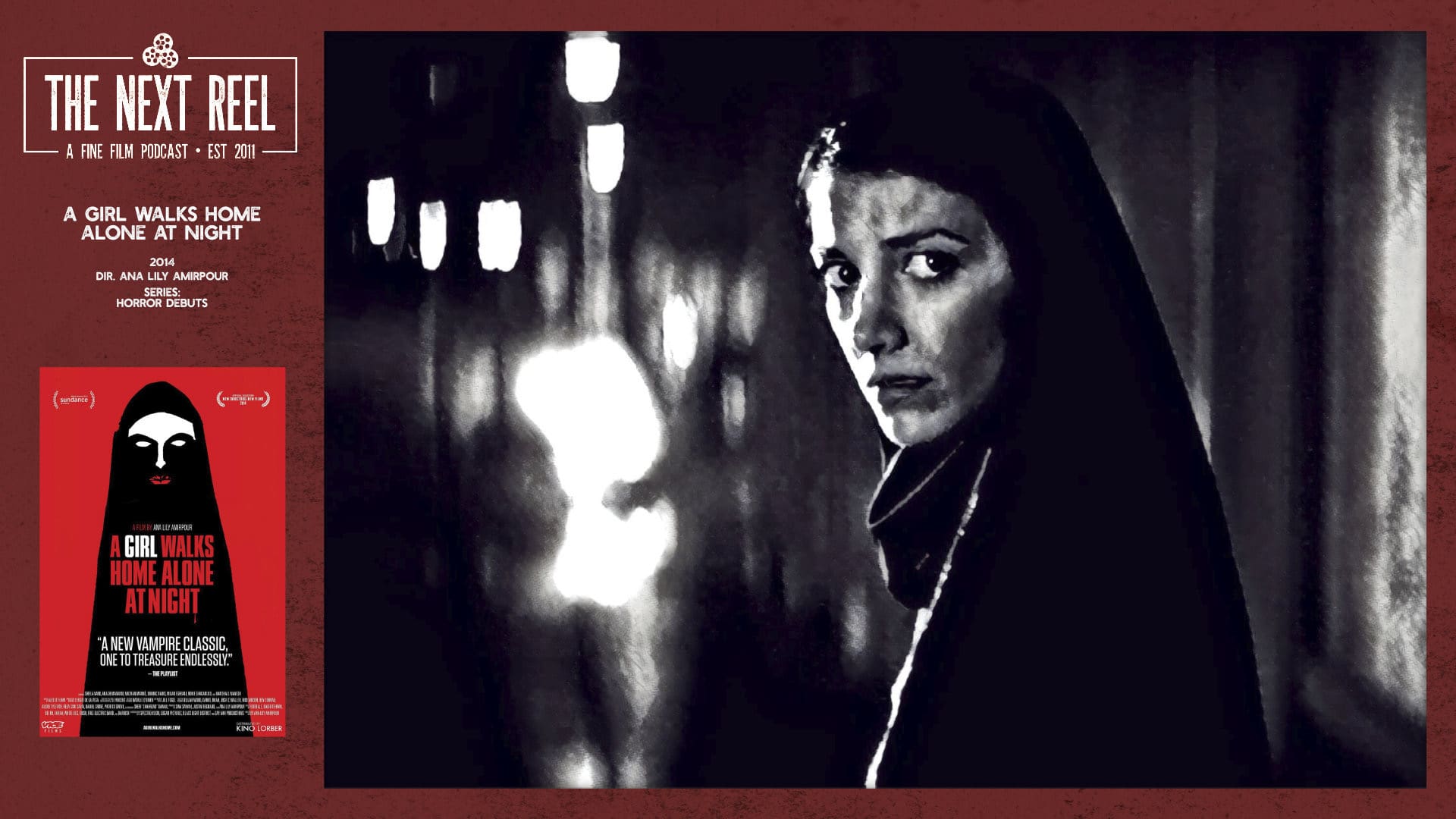
A Girl Walks Home Alone at Night is over. I’m bad. Andy, it’s number three. Number three of our Horror Debuts, with Ana Lily Amirpour’s film, A Girl Walks Home Alone at Night. Or, as you have so aptly written in the show notes, AGWHAAN.
Andy Nelson:
That’s right. AGWHAAN.
Pete Wright:
Why why are we talking about this movie?
Andy Nelson:
It’s a horror debut. This was Ana Lily Amirpour’s debut feature film. She had been fighting to get something made and managed to get in touch with all the right people for this particular film. Elijah Wood was one of the people who had read the script and loved it and came on board. He had been looking at doing some producing of his own sorts of things, and came on board as a producer for this film and really connected with it. And it is a very kind of — it’s a debut film that has a very kind of specific look and feel to it, that I think says Amirpour has a definite voice when she’s making a film. And I really enjoyed getting a sense of what she was exploring here in her debut feature film.
Pete Wright:
I’m addicted to her as a person.
Andy Nelson:
Well, it’s fitting for this particular film.
Pete Wright:
I guess it is. Have you watched any interviews of her, like, speaking?
Andy Nelson:
Mhmm, yeah. Do you—
Pete Wright:
—know what I’m saying? She’s so addictive.
Andy Nelson:
I watched the one where she’s talking to Roger Corman. You watched that one? It was like after a screening, he was moderating a conversation with her.
Pete Wright:
I didn’t watch that one.
Andy Nelson:
Just a delight. They kick it off talking about dropping LSD.
Pete Wright:
Yeah, she’s very open. But she’s also, like — and I say this with the greatest respect — she’s a skater chick, and just watching the way she interacts with the world is fascinating. It’s fascinating. I just love her personality. I love the way she thinks about things. We’re gonna talk about her perspective on loneliness and how it fuels her sort of creative arts. I’m really fascinated by her. Whatever we end up thinking about the movie, she is, for me, absolutely someone to watch.
Andy Nelson:
Absolutely. Her loneliness and her fear of death, which she talks about quite openly — the idea that she just really doesn’t want — she doesn’t like that idea, she would love to just kind of lock herself in where she is now and just kind of live forever. So it fits interestingly with this conversation. Well, this movie is actually not rated, but it does contain mild sex and nudity, moderate violence and gore, mild profanity, severe depictions of drug use, and moderate, frightening, and intense scenes. Our conversation will be touching on all of this as well. Do you wanna watch this movie and help us out? If you see an Apple or an Amazon link to this very movie in our show notes, all you have to do is just click on that, and it will take you right to their website, where you can rent or buy the movie. When you do this, they actually give us a tiny piece too. It’s like we’re the little baby bird, and they’re throwing up into our mouths a—
Pete Wright:
—little tiny bit for us. So that’s what it means when you say we get a taste — it’s the bird vomit. Great. We are also up in our game in the merch store, and in fact we had a big drop last week. So if you are listening to this and you haven’t checked the merch in a little while, you should check it out, because you might get the Blood Moon Centennial Celebration at Point Dume, California 1973 shirt, or mug, or sticker, or — did you attend the world famous Spicoli Surf School, established 1982? Get some tasty waves and cool buzz at the Spicoli Surf School. You might speak fluent Valley, or wanna know how much your puppies cost at Kelly’s Pet Store, or your alma mater — you gotta show off your alma mater if you went to Pac Tech. That’s up there too. There’s just a lot going on over at the merch store. The eighties comedy of Heckerling and Coolidge is all done, all the new art is up there, check it out. And we are moving on to the murderer’s row of horror debut logos that we’re dropping up there. So check it out. Support the show if you don’t wanna become a member. TruStory.fm/TNRmerch.
Andy Nelson:
We want you to record us a review. We’re gonna start including clips, thirty second audio files. Just record them on your phone in your voice memos app — just about a thirty second audio file, email it to us at reviews@trustory.fm. As soon as you watch the film, we just might end up showcasing your voice on the show. You gotta get them in quick though, because we record generally about two weeks before the episode drops. So just get them recorded, watch the movie, get them recorded, and send it into reviews@trustory.fm.
Pete Wright:
And anyone who’s a fan of Letterboxd, check out our new HQ page. You wanna get a discount on Pro or Patron membership of your own Letterboxd account, you can do that — just use the discount code NEXTREEL when you upgrade your account at Letterboxd.com, or you can just visit TheNextReel.com/Letterboxd, and the code will already be applied, it’ll take you to Letterboxd.com with the code already applied. You’ll get 20% off — Pro or Patron membership, and it works for renewals as well. Our annual questionnaire, or—
Andy Nelson:
—what do we say, quinquennial? The quinquennial questionnaire. The time for it is getting close to drawing too close. We’ve got a few more weeks for it to be up. It is at the top of the page at TruStory.fm/TheNextReel — there’s a questionnaire button, kind of a strip across the top, and you just click on it, fill out the questionnaire. We really wanna get some more feedback, your listening habits, what you like, what you don’t like, all of that good stuff. If you can just fill that out in the next few weeks, we would really appreciate it. And, as we’ve said before, one lucky listener who fills it out is going to get a free year of membership.
Pete Wright:
Hey, everybody, we need your support. You know, we don’t sell your info, we don’t use any dramatic and invasive ad targeting features on our podcast. We’ve decided to go the membership route. But in order to do that, in order to keep making these shows and keep growing, we do need your support. So if you have considered it at any time over the last ten years that we’ve been doing this show, we encourage you to jump over to our membership page, sign up for a few bucks a month, and jump in. You’ll get some perks, and you’ll really, really help us.
Andy Nelson:
We have our Saturday Matinee polls that go every week for the Saturday Matinee show. Members get to vote on those polls, they are in the Discord Show Talk channel, and with those polls they can choose the list topic based on the movie that we were talking about this week. If you were a member, you could have voted on the list topic for A Girl Walks Home Alone at Night already.
Pete Wright:
Members also get early access to every episode, and there are also so many bonus episodes. So many bonus episodes. It is ridiculous how many bonus episodes we’re doing this year.
Andy Nelson:
That’s right. There’s the monthly member bonus episode that fills a gap in from one of our previous series or current series. There is our monthly Flickchart re-ranking episode that drops on the fifteenth of each month. And as those of you who are curious about kind of a further exploration of each of our series as we do them — at the end of each series we’re adding a new members only episode called the Retake, and that is where we kind of do a macroscopic look at the entire series and everything we gleaned from it.
Pete Wright:
Members also get to vote on what we’re talking about in the member bonus episodes for each series, as we’ve got all kinds of new movies that we’re throwing into existing series, and members tell us what to do.
Andy Nelson:
In fact, members have already voted on the movie Relic. It is another horror debut that is going to be our September member bonus. So if you wanna hear us talking about Relic, directed by Natalie Erika James from 2020, become a member, and you’ll be able to hear that episode. Those member bonus episodes drop the last day of the month.
Pete Wright:
You can watch livestreams of the shows as we record them. We send an email out right before, and we drop a link into the Discord channel, so you can always keep up to date and chat along with the show, right there.
Andy Nelson:
And speaking of Discord, we have members only channels in Discord where members can have great conversations about movies and everything they love with other members. It’s a great perk.
Pete Wright:
And now stickers. We’re making stickers of a lot of things. You don’t know what stickers you’re gonna get — it could be one of our series stickers, it could be a show logo sticker, it could just show up in your mailbox like today. Probably not today if—
Andy Nelson:
—you’re not a member, but it could. And best of all, you don’t have to listen to all of this every single episode. That’s really the best thing you get out of it.
Pete Wright:
Might be the biggest perk. Might be the biggest perk, though. Head over to TruStory.fm/TNRmembership to learn more about our membership tiers. The most it’ll cost you is $5 a month or $55 a year.
Ad:
Meet Xenia. You are being very polite to someone who is attempting to kill us. Her wife, Saffron. You can plan all you want, but what matters is what you do when your plan falls apart. And their best friend, Goldie. Glad we didn’t miss all the fun. Swords in hand, they defend their city from the worst of humanity. I am Lord Buxton Blue. Vicious Swa. The Franconian Rake. Herr Hague. Equity Electric. Follow their adventures on the Swashbuckling Ladies Debate Society audio drama podcast. Available now at trustory.fm/swashbuckling.
Pete Wright:
Okay, Andy. A Girl Walks Home Alone at Night. What a movie.
Andy Nelson:
I don’t think this movie would have fit — this is a complete aside, but we had a list a while ago about movie titles that are complete sentences.
Pete Wright:
Yeah, this would have been it.
Andy Nelson:
This would have been a great one to include.
Pete Wright:
I can’t believe we didn’t think about that at the time. Whoever was on that show didn’t think about it. Probably you, and you just — this is a fat man failure. It is an Iranian feminist vampire spaghetti western movie shot in luscious black and white, and it is an amazing film. I have to tell you, I watched this film, and I don’t think I liked it maybe as much as I felt I should have. And then it just ate away at me, so to speak. Like, it’s one of those movies that I thought I was gonna stop thinking about, and I didn’t stop thinking about it. I just keep thinking about it, this movie. How did it hit you?
Andy Nelson:
Well, one — I’m surprised that you didn’t ask me what I thought your reaction to it would have been.
Pete Wright:
Oh, no. You totally — what would you have said?
Andy Nelson:
I don’t know. I think that I thought that you would have ended up struggling with this one. So I think I probably would have been right until you thought about it more — until I had to weigh you some more.
Pete Wright:
Your gut check answer would have been right on the money.
Andy Nelson:
Exactly. But so now I’m gonna turn the tables on you. I’m gonna say, what do you think I’m gonna say?
Pete Wright:
I think you loved it.
Andy Nelson:
I did. I really loved this film. I found the pacing, the mood, the tone of the whole film just really exciting and different, especially with the music choices that Amirpour included, which — I mean, this soundtrack was just phenomenal. I just want to listen to it all the time. It was just so great. But the idea of this vampire woman creeping around in the streets of Bad City at night on the skateboard that she takes from this child, I really liked. And the way that it’s talking about this idea of being alone and isolated and addictions, and this idea of feeding upon the land and feeding upon society, kind of society’s ills with the addictions and everything — there were so many interesting things to think about in context of what she was doing with this film. But also, I found it was a really touching love story that I completely connected with. Watching Arash and our young vampire find a connection, really powerful. And the scenes with them, I found incredibly haunting and romantic. I just really did love this film. It’s great.
Pete Wright:
I love it more, understanding more clearly what it’s saying. I didn’t know anything about this movie going into it. I’d heard of it, I hadn’t seen it when it came out, I had heard good things, that people like it. So I was really looking forward to watching it, and that it was an Iranian vampire film — that was the extent of what I knew about it. And so I guess I expected a vampire film. I was curious what I was gonna get, because I know how restrictive it is making films in Iran and the sort of cultural restrictions that go into it. And so I was surprised watching this movie. Some of the things that we see, we see a lot of romantic love and violence, and it’s a movie that just didn’t seem like it could possibly be made. Amirpour is making a movie in California about Iranian vampires with actors here and present here. Of course, she could get away with a lot of stuff. And in that regard, it becomes a blooming onion of statements. Right? She’s making a movie here intentionally in Farsi because she can say things about this culture, which is ostracizing and challenging and restrictive, and also an exercise of deep patriotism. That conflict, I think, that she is experiencing herself, is right on the sleeves of this movie, and it makes it more fascinating for me to experience it, knowing that, than just watching it cold.
Andy Nelson:
It’s a film to think about. And it’s interesting, because I feel like everything’s there. It’s not a film where you really have to think about the symbology or anything, it’s kind of just there. But in context of the way that she’s putting the film together, it — I don’t know, I just find that it’s such a patient film. It’s kind of the pacing, it’s just kind of a slower paced film, as you kind of move through the night with the girl as she’s kind of stalking various people, and as Arash is doing his job and doing whatever, it’s kind of patient. And you get that sense, like, right from the beginning, as you’re watching Arash just kind of standing there smoking, looking like, is he doing something suspicious. And then he kind of goes through a doorway and comes out with a cat and walks off with the cat. You’re like, okay, what’s up with this guy? And as you kind of continue watching, you see him, and the way the music is playing, and things kind of slow down — the music slows down, the film itself slows down. The title comes, like, pounding up onto the screen. There’s just a style that she has determined that she’s gonna use as she makes this film and puts everything in here. And I don’t even know if she is overtly wanting to kind of put all of those messages there, as much as she’s wanting — when you hear her talk, it sounds like she’s really just wanting to make kind of a really interesting love story, is kind of what she’s doing. But I like that she’s including all of these other things, because it gives you so much more. And she may not overtly be talking about this society that has this patriarchal structure, or is very oppressive. But just by including it, as you said, in this environment where it’s in Bad City, they’re speaking Farsi, it’s kind of an Iranian story, but it’s not in Iran — she is allowing herself to have all of those elements there, that are pushing at what that actual society allows, while she’s telling this love story. And I think that was a really interesting way to approach it.
Pete Wright:
I do too. She calls it out, right. It is for her a counterculture John Hughes movie. She says it’s like a John Hughes film — the outcast is trying to fit in, and then at the end of the movie she realizes she’s better off being herself and being with the people who really appreciate her. It’s there, right on its sleeves. And as such, it leaves me with this open question that — you already talk about, like, the look of the film, and I deeply appreciate the look of the film, and it’s very patient, and I love the black and white. It’s just crisp and beautiful. And as I’m watching the movie, there were times that I would stop and say, come on, let’s move along, let’s move it along a little bit, let’s move the pacing. It seemed to be a little bit inconsistent for me, and I would want it to just forge ahead and show me the next thing. We’re holding a little bit too long on these lingering, you know, two shots, and I wanted a more active camera. And so I wonder — and I’ve come to appreciate that more in hindsight, the gift of hindsight and research — but I wonder if that’s a disservice to the film, that it moves so slowly in some places that, you know, if you don’t go through the motions of looking into the film and researching the filmmaker and the team behind it, that it doesn’t end up hurting the film for new audiences.
Andy Nelson:
It’s interesting. I didn’t have that reaction where I felt like the pacing ever was starting to, like, be too slow, or that it wasn’t working right for me, from the beginning. For me, it just, like, I clicked with the mood as soon as I started watching it, and I’m like, oh, I am so in the vibe for this. And it just rolled along, and I never felt that. But I’ve heard that, you know, I’m just reading other reviews and looking at what other people had to say, it does seem to be a thing that strikes people, is that the pacing can be a little lethargic.
Pete Wright:
But, I mean, Andy, do you wanna show them the note that you got from Amirpour? When she sent you that letter that says, dear Andy, I made a movie just for you, gonna tickle every one of your film nerd vibes.
Andy Nelson:
It totally did. It totally did. I should — after I typed that letter up, I’ll—
Pete Wright:
—I’ll post it.
Andy Nelson:
It just it really did click with me. But I mean, I think that’s an interesting thing, because I think, because it was a film that affected you, it kind of allowed itself to kind of get into those cracks. And I think—
Pete Wright:
—yeah—
Andy Nelson:
—now if you watched it again, you’re probably not necessarily gonna have that same reaction that you did the—
Pete Wright:
—right—
Andy Nelson:
—first. And I think that’s the strength of, you know, a film like this. And also, I think for me, it just shows that Amirpour definitely had a style and a tone that she was going for, and I think she succeeded. Now I haven’t seen — did you watch The Bad Batch? Because I know that was her follow-up film, and it’s been on my list forever. I just have never gotten around to it. So now I really wanna watch it and get a sense as to how that one unfolded.
Pete Wright:
The way I understand — I mean, she, when she talks about her experience, the last interview I watched was 2014, when this — when she was doing the press, and she had said at that point she’d written 12 screenplays, and she was trying to get — she had two of them that she was really pushing to try and get produced, and realized that this was — I mean, she had gone to Germany, and she was a resident filmmaker in Germany for five months, and she made a film, you know, that combination stop motion and live action. And she said, this is ridiculous, why don’t I just make a movie myself? And so she wrote this, like, in a month. And it was, as she talks about it, the most precise bit of scripting and filmmaking that she’d ever done. So the full on storyboards, writing for each actor that she had in mind, and you can really feel it, that sense of precision in this movie. It’s a razor blade. And I think it works really well. To your point, I’m really interested in watching what comes next from her, because it sounds like this was a big lessons learned movie for her, that she’d been trudging for a long time, and defined her sense of Amirpour-in-filmmaking on this movie.
Andy Nelson:
She did. She definitely did. And but it’ll be interesting to see The Bad Batch, because I’m curious — we’ve heard this from filmmakers throughout time. Like, even still, Steven Spielberg, when he was making Jaws — when you don’t have as big a budget and you can’t show the monster all the way through the entire film, you really have to think more outside the box and more creatively in order to find the way to construct the film. Hence why Jaws worked so well. In a story like this, where the budget was low, it was a low, you know, indie budget type of project — does that end up helping her kind of define her vision more? And with a bigger budget project like The Bad Batch, is it a little more diffused across the project? So I’ll be curious to see that one and get a sense.
Pete Wright:
Me too. Let’s talk just a little bit about the vampire part of it. Right? Because you talk about effect sequences, I think we need to talk about the horror. How well does the vampire work for you?
Andy Nelson:
I mean, I love it. It’s really interesting. The black and white’s great, because blood just ends up looking black, which really blends in with her chador. So you can’t really tell — is she covered in blood? Who knows? It just all looks black. I think that’s kind of clever, the way that ends up playing. But it’s also really kind of frightening, the simplistic way that they went with the transformation, because you see Saeed kind of caressing her face and everything, and she starts kind of, like, sucking on his finger. And then the way that they show her teeth — they’re not retracting, they’re popping out, the opposite of retract. It’s so quick, and it’s just such a little — it’s almost like spring loaded teeth that just kind of pop down.
Pete Wright:
Mhmm.
Andy Nelson:
Which, you know, surprises him. And then she just goes to town and bites his finger off, and — I mean, I loved the way that that scene played out. She bites his finger off, takes his bloody finger, and is now doing the same stuff to him that he had been doing to her, caressing his lips with his bloody finger before she attacks him. And the attacks are very mild, indie budget types of attacks, where basically she and her chador just basically, like, in fast motion just kind of leap onto their throat, and we don’t really see the feeding, we just know that she’s draining them of their blood. It was simply done, and I found it to be quite effective.
Pete Wright:
The restraint of not worrying about showing a lot of gore in this movie is the Jaws effect, right, that it can still be scary when you just look at the whole predator prey relationship. And I think that works exceedingly well, and it becomes more of a dance with the camera and framing than with just more blood. And to your point, the blood on her mouth makes for some incredible lingering still shots on her as her eyes look up. I think Sheila Vand is a perfect casting for that part, and is able to channel a real haunting energy. But back to that point, I wanted to look at the sequence where she attacks the drug dealer. The pimp, Saeed. When she walks into the frame, and there’s a lovely video essay on this sequence that I found just perfect, and pulls apart a lot of stuff that I did not notice in the film the first time. And having watched it just the once, right before we recorded this, I feel like I need to go back and watch this sequence again a dozen times. She really is building a predator prey, like, cage with the camera, and it’s just perfect. If you watch the scene as she comes in and is standing on the stairs, and he is doing his — doing the drugs on the couch — the bottom half of the screen is full of tigers, he’s tattooed with tigers, there are tiger blankets all over everything. And the top half, where she’s standing, is like gazelle heads. It’s the prey. And as she moves through the frame, you see that the camera is actually pushing her into the predator mode and him into the prey mode, until finally he’s with the gazelles and she’s with the tigers, and you realize, oh my god, this has visually told me the story before I even got to the point where she kills him, as she takes the dominant role in the scene. It is another example in this movie of many wonderful examples of assumed control of men in assumed presumed control and power positions, and her taking that power and relieving them of that presumption of control. And it is, it ends up being a lovely sort of visual sequence of violence demonstrating that transition of power, and I’m here for it. I just really love it. I think she is great.
Andy Nelson:
There’s an interesting element to that, that I think is worth talking about, because we see her take down several people. The first one is Saeed, the drug dealer, drug dealer slash pimp slash—
Pete Wright:
—you know—
Andy Nelson:
—basically the one gangster in this little tiny town. And she takes him down, and we pretty much feel okay with that, because we’ve seen how he behaves, we’ve seen how he treats the people who are addicted to his drugs, we’ve seen how he treats the prostitute that is working for him. He’s just a terrible, terrible person, and we don’t like him, and that’s set up really well. Then we see her pacing and following along with Hossein, who is Arash’s father, who is an addict, and which is an interesting little frightening scene, the way that she’s just kind of imitating him from one side of the street, and he’s on the other. And it finally freaks him out too much. He runs home. As she’s following him, she ends up coming across that kid. Why he’s out walking in the middle of the night?
Pete Wright:
I have no idea. Weird.
Andy Nelson:
But he is. And that’s a really frightening scene where she actually has a confrontation with him about, don’t be bad. And takes a skateboard, and it’s just almost like an interesting lesson — be a good person, or I’ll come for you when you’re older type of thing. Later, we see her take Hossein after he has just kind of really mistreated the prostitute, in really kind of a horrific scene, the way that he ties her up and forces her to take this drug with him. But then there’s the one killing that I wanna talk a little bit more about, because it’s the only one that I guess she’s just doing, as saying she still has to eat, even if it’s not a bad man. There’s a shot of, like, a homeless person, like, passed out on the side of the street, or sleeping on the sidewalk. I don’t know. But just sitting there, and she comes up to him and attacks him. And it’s, I think, maybe the second kill before Hossein. What do you get out of that one? Because that one isn’t necessarily going after one of these, quote, bad men.
Pete Wright:
That’s a great observation. And I — if, to me, and I think you can apply the same thing to the ultimate end of Hossein, who is, you know, obviously undone by the drugs — that she is a complex, like, this invented lore of the vampire in this movie, she’s a much more sort of complex creature, I think. And in introducing us to her darkness, her relationship with Arash demonstrates that — it, she also has this range of, like, coming to terms with her love and lust, and also pity. Like, to me, her exercising violence against, you know, the junkie in the alley, and ultimately Hossein, could be seen as an act of pity, that she’s ending their existences because of their suffering. And so she — I, you know, I like to think of her as a character with more than just one trick.
Andy Nelson:
I didn’t assume that it was a junkie necessarily in the alley. I’d have to look again, but as memory served, it was just a person who was, like, sitting down up against the wall of a building in the middle of the night, presumably sleeping. So I just assumed it was just a homeless person, but I guess it could be a junkie who had passed out, just living there on the street. And so I thought that that was interesting, that that was a kill that we end up seeing. And I was wondering, because the other ones felt so purposeful, this one just felt more, I’m just hungry. And I guess to that end, I mean, maybe it’s just an element saying, you know, she still is out there cleaning up the streets, doing her bit, I suppose.
Pete Wright:
I don’t like thinking of her as, you know, quote, eating without purpose. I really think that she’s set up as a creature of more complexity. I prefer that in my take on the character. And maybe that is to that example — that setup is not great as a result. That setup doesn’t directly speak as well.
Andy Nelson:
But eventually she’ll get to a point where she will have eaten all the bad people, and she’ll just have to feed on everybody else.
Pete Wright:
That’s actually a really good question. Like, will — what is the — is the film saying anything about that? Will Bad City ever run out of bad people? I don’t know.
Andy Nelson:
I don’t either. I mean, it’s certainly there’s not a lot of people walking around at night.
Pete Wright:
Yeah.
Andy Nelson:
It makes me think that, you know, she might be close to having cleaned it up, which maybe is why she leaves at the end. Who knows? Who knows?
Pete Wright:
But no. I mean, that’s why — why did she leave at the end? I don’t think it’s because she cleaned up the city and was done. I honestly, like, I love the John Hughesiness of it. Like, she found a guy that appreciates her and is able to appreciate her after discovering that she killed his dad. Like, he knows her worst bits and still got back in the truck and drove away with her. I love that. That is really touching.
Andy Nelson:
It is, honestly. And, I mean, yeah, I’m being a little cheeky as far as kind of having cleaned up Bad City. But I do like the idea of this relationship that forms between her and Arash. And, I mean, that’s a really interesting kind of character there that we have in Arash. Because obviously, she’s doing stuff that is bad, but so is he. He’s not happy with the kind of the quote career path he’s taken. He’s, you know, basically working as a landscaper for one of the rich families in town, as we see when he’s invited in by the daughter to fix the TV and then ends up stealing some earrings. He’s out for himself, and he’s trying to figure out a way to get ahead. And he takes advantage of the fact that once he finds Saeed dead — he doesn’t know it’s her, but he finds Saeed dead, and he’s like, well, great, now I’ll take over. And he becomes — yeah, I mean, he’s not pimping anyone out, but he is the drug dealer, he’s taking all the drugs, he’s hooking up his dad, and he’s selling X to girls at the club. He ends up kind of filling in that hole that was left when Saeed left. And so he’s got his own issues. And so that’s what I liked, is when he kind of discovers that about her, I think that there’s an element of, you know what, we all have our issues. We all have stuff that we’ve done that we’re not proud of.
Pete Wright:
Me too.
Andy Nelson:
And he’s willing to kind of get past that and move forward. And I think that their meetings, I find so touching in this film. Like, when he’s dressed in the vampire outfit at the club, from the costume party, when the girls kind of make him take X, and he’s kind of tripping, and the girl, or the vampire, comes across him just staring at a streetlight in the middle of the night. And then they have this really touching conversation as he connects with her. And I think that’s that is what really surprises the girl, is he actually isn’t into, like, trying to take her home to go to bed with her or do anything creepy. He actually just has, like, a conversation with her. They sit on the sidewalk and have a nice conversation. And I found that really interesting, the way that it affected her, and it kind of shifted her mindset a little bit.
Pete Wright:
I don’t know if I completely saw him as taking over. Well, I’m curious your thought on his intention for taking over the drug stuff. He’s set up as a caretaker, right, in the beginning, with his relationship with his dad. He’s worried about his dad, he’s trying to take care of him. Right? That’s absolutely what you see. So when Saeed is killed and he discovers — one, he gets his car back. That’s an exciting thing, because he lost his car. Big bonus. But then he takes the drugs. And the way I watch it — I guess I’m watching it with maybe a more sympathetic eye, because I feel like Arash is selling the drugs as a boost to his ultimate ends, which is finding satisfaction in a new career and getting his dad the help that he needs, and that maybe he’s just doing this as a means to an immediate end. I didn’t get the feeling that we were gonna see him become the next, you know, drug dealer in Bad City.
Andy Nelson:
And, I mean, I guess that’s a good observation, because, yeah, I guess the question is, like, once he finished selling the stuff that was in that briefcase that he took from Saeed’s place—
Pete Wright:
—what would he do next?
Andy Nelson:
Yeah. He’s saying, I’m gonna take this, I’m gonna sell this stuff, take that money, and get out of town. And I have a feeling — I mean, he had pretty much kind of given up on his dad. Speaking to that relationship, his dad could not get off the junk. And he was he had kind of had it with his dad. And even there’s a point where he just, like, he’s so fed up, he just, like, gives his dad a bunch of stuff — here, just take it, I’m done. I’m not gonna do it anymore. Take this and get out.
Pete Wright:
Mhmm.
Andy Nelson:
And I think that, yes, he does find out, because of the cat, that the girl is the one that had killed his dad. But at the same time, I think when he kicked his dad out, in a way, he kind of had also killed his dad. Right? He gave him the drugs and everything and said, get out. His dad very easily could have just gone and sat on the side of the street, shot up, and overdosed.
Pete Wright:
Yeah. Right, right. That’s true. That’s true. And so is it more of an exercise of when, just as a human being, we run out of sympathy? He just became exhausted with that role that he had taken on.
Andy Nelson:
Well, and it’s, I mean, and this is the frustrating thing with addicts, and that’s what I found interesting about the film, is, like, until they’re ready to make that change, like, you just can’t, you can’t keep fighting it. I mean, you can put them in treatment and stuff like that, but they have to be the one that’s ready to make that turn in order to ever get better. And he, I think he had been hoping maybe that his dad would do that. And by kind of helping his dad out, I think he was hoping that at some point that would happen. And I think at the end he realized his dad’s never gonna change. His dad is just buried into this addiction and won’t give it up. And his dad was gonna end up dead, whether it was from the drugs, or living on the streets, or a vampire. And so, yeah, I think it was just a matter of time, but I think he had to cut the cord. And that’s the hard part, I think, for people who have family, friends, loved ones, who are addicts, is figuring out how to cut that cord and get free from it, which is another interesting element in this film, as he finally does kind of cut that cord to get out of town. And even with the drugs, I didn’t have a sense as he was leaving town that he was going to take the drugs or continue selling it wherever he ended up.
Pete Wright:
Exactly. But that — I was just gonna say that, because this was definitely an escape from the town and the life in the past, but also running toward a new relationship with the girl. And that to me is the more sort of weirdly hopeful part about this movie, that it ends on a note where there’s promise in the future. It’s just not — it’s not bleak. It’s weird, but it’s a love story.
Andy Nelson:
It’s weird. It is a love story. And that’s another thing, I found so touching — the moment outside of the, you know, where all the rigs are, in the power plant and everything. When the train goes by, you have that moment where she wants to have her ears pierced and asks him to pierce her ears with a needle, which he does, and it kind of triggers her teeth and everything. I thought that was just really interesting.
Pete Wright:
Yeah, but—
Andy Nelson:
—also, I’m like, what an interesting element to insert into a vampire story, where she’s the one with the fangs, but in a weird way she’s having him bite her. Right? And I was like—
Pete Wright:
—that’s reciprocal. That reciprocal relationship, like balancing their position together, I think is really lovely. What a weird movie.
Pete Wright:
After seeing this movie, I also kinda love that.
Andy Nelson:
I just hope that there’s a raccoon. A moment where a raccoon falls off the line.
Pete Wright:
It was so much. That movie was so much. I think she’s a thrilling filmmaker, and I — you know, as much as this movie, and I think you said it early on, that so many of the reviews, I think, capture what my initial thoughts were. Was this just not enough? Like, the movie — it says exactly what it says right on its sleeve. And, you know, and the question was, is it enough? Like, is it enough just to enjoy the look of the film? And I think, you know, arguably, yes. I think there is enough film to like the movie, make a statement. I think there is so much more film once you start actually thinking about what it represents. That it was a delightful watch. I really enjoyed it.
Andy Nelson:
Well, let’s not do our wrap ups just yet, because we will be right back. But first, our credits.
Pete Wright:
The Next Reel is a production of TruStory FM, engineering by handsome Andy Nelson. Music by Sémø, Oriol Novella, and Eli Catlin. Andy usually finds all the stats for the awards and numbers at The-Numbers.com, BoxOfficeMojo.com, IMDb.com, and Wikipedia.org. Find the show at TruStory.fm. If your podcast app allows ratings and reviews, please consider doing that for our show.
Andy Nelson:
You know, we didn’t talk about the fact that she started this with a short film. Had you seen that one?
Pete Wright:
No, I haven’t watched anything.
Andy Nelson:
Yeah, I hadn’t seen it either. It screened at festivals. It was very simple, it was largely the story of her and Saeed, basically. It’s a man seeing this woman out in the streets, and invites her home, and seems like he’s the predator and she’s the prey, and then it turns out she’s a vampire. And that was kind of the short. And then she used Indiegogo to launch a feature version, and that’s where she started trying to raise money and get it going. So, yeah, I haven’t seen the short film, and I wonder if it’s on YouTube. We should track it down.
Pete Wright:
I cannot find it. I’ve been real time tracking it down right now. Maybe Vimeo.
Andy Nelson:
I was surprised it wasn’t on the disc, as a bonus feature.
Pete Wright:
I am also surprised by that. Now the movie was only made in 2014. Has there been time for sequels and remakes?
Andy Nelson:
No, I don’t think there will be one, but it was adapted into a graphic novel series. The series of six issues, published by Radco, and it explored her backstory. Michael DeWeese did the art for it. And if you watch any of the bonus features, you’ll see that Ana Lily Amirpour, like, she came up with the girl’s entire backstory, like, through all of history, and knew how old she was, and she—
Pete Wright:
—like a 185 years old.
Andy Nelson:
She had the whole thing figured out. So it’s pretty interesting. So, yeah, it’s out there if you wanna track down the graphic novel series.
Pete Wright:
It’s part one in the Girl-iverse. Is that right? Girl, girl… no. No. Still not working. Okay, we’ll workshop it. We’ll take it to the lab.
Andy Nelson:
There you go.
Pete Wright:
How’d it do at awards season?
Andy Nelson:
It did well for itself. This film had eight wins, 23 other nominations. At Sundance, it was nominated for the Best of NEXT Audience Award, but lost to Malik Vitthal for Imperial Dreams. At the Rondo Hatton Horror Awards, it was nominated for Best Independent Film, but lost to What We Do in the Shadows.
Pete Wright:
I’d love that film. Oh, man.
Andy Nelson:
At the Sitges Catalonian Film Festival, it won the Official Fantàstic Selection Carnet Jove jury award. It won the Citizen Kane award for best directorial revelation for Amirpour, and Amirpour also won a special mention. And at the Film Independent Spirit Awards, the film was nominated for best first feature, but lost to Nightcrawler. It was nominated for best cinematography, but lost to Birdman. And Amirpour was nominated for Someone to Watch, but lost to Rania Attieh and Daniel Garcia for the film H.
Pete Wright:
I haven’t seen H.
Andy Nelson:
I haven’t either.
Pete Wright:
How do you feel about Nightcrawler, Birdman, those particular wins? Those are tough — What We Do in the Shadows?
Andy Nelson:
Yeah, they’re tough ones to call out as mistakes. I think I would have been happy either way in any case.
Pete Wright:
Yeah. Yeah. All of those movies are more complex films, just in terms of the finished product.
Andy Nelson:
Yeah.
Pete Wright:
And I can see why there might be some weighting against this one.
Andy Nelson:
Yeah. No. Right.
Pete Wright:
How did you at the box office?
Andy Nelson:
You know, it’s hard to say what the actual budget was for this film. But if Indiegogo is to be believed, the full budget raised by the site for the film’s production was $56,903. Films have been made for less, so it’s entirely possible that this was the full budget. So I’m just gonna go with it. That is $61,500 in today’s dollars. This movie had a very limited indie release on two screens after its festival run, opening 11/21/2014, opposite The Hunger Games: Mockingjay Part One, Penguins of Madagascar, and Horrible Bosses 2. Talk about counter programming.
Andy Nelson:
This never screened on more than 19 screens across the country, but it did enough to earn its money back, assuming that it did have that little budget, earning domestically $544,000 and internationally $97,000, for a total gross of $693,000 in today’s dollars. That lands Amirpour’s film with an adjusted profit per finished minute of $6,377, and marks it a success.
Pete Wright:
And that’s why she’s directing Cliffhanger.
Andy Nelson:
And that’s why she’s directing Cliffhanger.
Pete Wright:
Yeah. Well, what a fun excursion. Interesting film. Looks great.
Andy Nelson:
I really enjoyed it. Yeah.
Pete Wright:
Yeah. With that, Andy, I think we should — I think we—
Andy Nelson:
—should rate it. Well, we will. But first, we’re gonna listen to the trailer for next week’s movie, Jennifer Kent’s The Babadook. Babadook. Babadook. Babadook. Have you seen The Babadook? We want to know what you thought. Again, send us your thoughts in a thirty second audio clip, and we’ll get your review in the episode. Just send it to reviews@trustory.fm.
Pete Wright:
You know what you should do though? Also, even if you just want to send us your rendition of the Babadook, you could just do that, and we’ll put a whole string of them in the show.
Andy Nelson:
Oh, we sure will. Oh, we sure will.
Trailer:
Where’d you get this? On the shelf. If it’s in a word or it’s in a look, you can’t get rid of the Babadook. A rumbling sound, then three sharp knocks. Babadook, dook, dook. That’s when you’ll know he’s around. You’ll see him if you look. Nothing bad’s gonna happen, Sam. Did he think that about my dad before he died? He sees things as they are, that one. I promised to protect you if he promised to protect me. Oh my god. Did he hurt anyone? The boy has significant behavioral problems. This monster thing has got to stop, alright? It’s just a book. It can’t hurt you. You alright? Yeah. Yeah. No. I’m fine. You don’t have to be fine, you know. Just a bit stressed at the moment. All children see monsters. Not like this. I want to report someone stalking me and my child. You can’t get rid of the Babadook. Real. It is real.
Pete Wright:
Letterboxd.com slash The Next Reel, Andy. We gotta drop our reviews in there. What do you think? What do you think? Is this a six star? Like, two beating hearts, or a four chamber bovine heart?
Andy Nelson:
I’m torn on this one. Because part of my world says that this could be a five star film. Part of it says, you know, it’s probably a four star film. So I feel like for now I’m gonna say it’s a four and a half star film with a heart. I really like it. There’s so much going for it. I think on later watches it could go up. I’m hard pressed to say it would ever go down. I just felt like this was just such a great film. I really enjoyed it.
Pete Wright:
It is a safe four star film. It was a three star film to start for me, and then I looked into it and really enjoyed it because of the research. But as a result of that, it makes it a film that I recommend to others with qualifications. Right? That this is a great film if you like, or it’s a great film if you know this little bit of backstory, and that’ll make it better. So I feel like it’s a four star film, because it’s not one of those, like, chilling experiences every time I watch it. I’m with you, it could go up, it might go up. I need to watch it a few more times. But the heart is there because I’m looking forward to watching this a few more times.
Andy Nelson:
100%. 100%.
Pete Wright:
So what did you think about A Girl Walks Home Alone at Night? We wanna know. Hop into the Show Talk channel on our Discord server, and we’ll be talking this week about this movie.
Andy Nelson:
When the movie ends—
Pete Wright:
—our conversation begins. Letterboxd giveth, Andrew, as Letterboxd always doeth. I went low. You went high?
Andy Nelson:
I went high.
Pete Wright:
Okay. Let her rip.
Andy Nelson:
I ended up kind of doing what you did last week. I went five stars, but I went, you know, looking for the really popular reviews, just, you know, I wanted to hang out with the popular kids today. Five stars, written by Lauren, who had this to say: sometimes the family is just a sad boy, his fat cat, and his vampire girlfriend.
Pete Wright:
And the sad boy. The sad boy and the fat cat and the vampire girlfriend. Maybe that needs to be our shirt for this movie. Mine is a half star, which was based on a rewatch by Allegra. And Allegra didn’t like the movie as much. Says the following: Damn, I’m currently going through my phone and personally apologizing to anyone I’ve recommended this film to, and especially with so much enthusiasm. My excitement about the film was based on an obscured memory of watching it the year it came out, 2014, also a year I was high all the time. Maybe that explains it a little. Upon rewatching, I couldn’t believe just how unpolished and scattered and without purpose this movie was. I remember loving the music, but it was even cheesy this time around. It had so much potential throughout to redeem itself and scratch a little deeper than the superficial glossed over thesis of the film. But it’s like everyone just gave up mid scene each time, even though it was so stylized and continuously switched its style, like hopping from reference to easy reference, or trying on different hats to try to fit in, or just to be justified. Now I will return to my sincerely apologetic texts. I regret ever having pushed this movie so hard. I blame my bad memory and idealism. Forgive me. Heartfelt.
Pete Wright:
But it kinda gets into what I was saying about my review of this film. I think I could have, in another universe, been somebody to write this review, that I get it. Like, I get how you can see that. And I guess I’m looking at it through a much more optimistic eye.
Andy Nelson:
Yeah.
Pete Wright:
Aw. Aw. Let’s go back to sad boy and a fat cat. Please. Thanks, Letterboxd.