***This transcript is produced using transcription software and reviewed for quality. Despite our best efforts, some passages may be incomplete or contain errors due to audio quality or software limitations.***
Pete Wright:
I’m Pete Wright.
Andy Nelson:
And I’m Andy Nelson.
Pete Wright:
Welcome to The Next Reel. When the movie ends,
Andy Nelson:
our conversation begins.
Pete Wright:
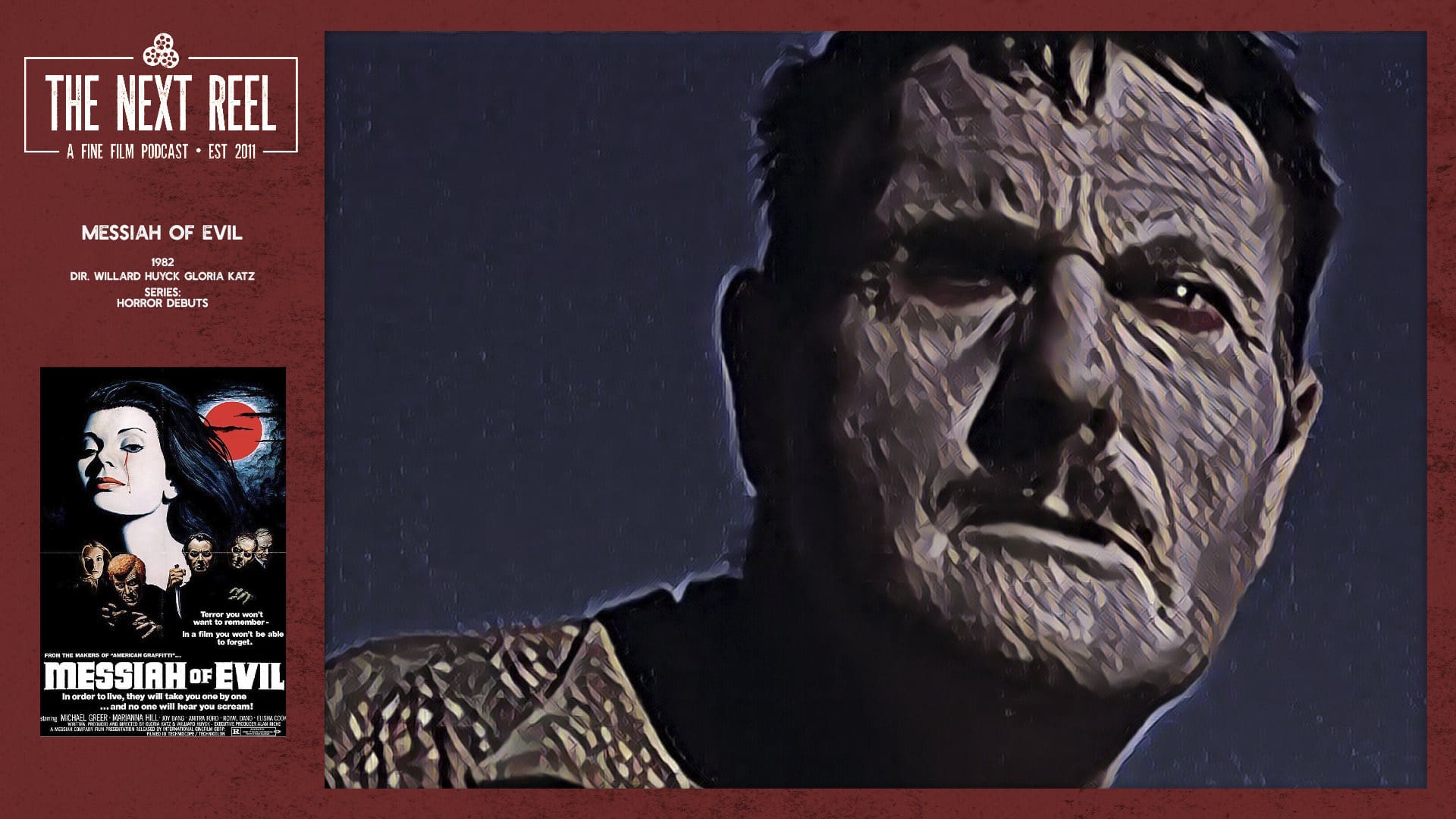
Messiah of Evil is over. “You’re not supposed to eat the fuzz.”
Trailer:
They say that nightmares are dreams perverted. I’ve told them here it wasn’t a nightmare, but they don’t believe me. They nod and make little notes in my file. Not far from here is a small town on the coast. They used to call it New Bethlehem, but they changed the name to Point Dume. After the moon turned blood red, Point Dume doesn’t look any different than a thousand other neon stucco towns. But what happened there, what they did to me, what they’re doing now.
Pete Wright:
Andy, we’ve got a new series. I don’t know if you knew this. We’re kicking a new series off today.
Andy Nelson:
I like it.
Pete Wright:
Uh-huh. Horror Debuts. Andy, how did you ever talk me into doing this whole series?
Andy Nelson:
Well, you know, Pete, as you keep saying, you’re kind of big on horror now. I love horror movies now. So I’m like, you know what? I’m gonna sneak this in. And I think this is a fantastic opportunity to just test exactly how far you have come with horror. So, you know, we’re looking at six films, and it’s gonna be an interesting experiment to see if Pete really does love horror, or if he ends up leaving this series with his tail between his legs.
Pete Wright:
Let’s start with a little tease from you to me, which I will not confirm or deny at this point in the show. What do you think my opinion is of this movie? Given how long we’ve known each other.
Andy Nelson:
Okay. Well, I don’t think that you found it scary. I think that you found it to be an interesting, unsettling experience, with story problems.
Pete Wright:
Do you have that saved in your brain as a template? I was trying to figure out where did the stars start falling for him. Well, I particularly like this series because we get to look at, as we’re doing with our entire year, women directors in the genre, particularly at the start of their careers. The biggest question for me is, does this feel like it has the sensibility that it was directed by a woman director? Is that even relevant at all? Not sure. We’ll talk about it. It is interesting because it’s credited directly to Willard Huyck. Huyck?
Andy Nelson:
I think we said Huyck.
Pete Wright:
Yeah, Huyck. Huyck. Willard Huyck. And so what are we doing with Gloria Katz?
Andy Nelson:
Well, it’s very interesting that they got in early with George Lucas, with Francis Ford Coppola and Zoetrope and all of that. And this was a project that they were working on together while they were writing the different drafts of American Graffiti. So it’s interesting to kind of put that into perspective here. The two of them largely were kind of a co-writing pair and co-producing, co-directing. It sounds kind of like the Coen brothers, where one would take the producer credit, one would take the director credit, at least certainly at this point in the career, while they were making their projects. And, you know, there’s a lot of stuff that you have to kind of work through with the DGA as far as co-directing. They really like just having one name as director on their films. So I don’t know if that was the reason that Gloria Katz didn’t get credited, but it has since come out that they really did co-direct this, and she’s just uncredited as director on the film. So I don’t know if that speaks to women as voices in horror films in the early seventies, the fact that he ended up getting credit and she didn’t. If they were concerned about trying to get into the DGA, and so just one of them went that route and one of them went the producer route, it’s unclear. But regardless, I think it’s an important thing to still include in this series of women directors, because Gloria Katz, obviously with Willard Huyck, had a very kind of specific voice that she was kind of including here in this. So it still is worth including in our series. And is rated S for scary? This film is rated R for violence and terror, some language, and some partial nudity. Do you want to watch this movie and help us out? If you see an Apple or Amazon link to this in our show notes, all you have to do is click on it, which will take you to their site where you can rent or buy the movie. When you do this, we get a little tiny piece in return.
Pete Wright:
It’s a win-win. Andy came up with a shirt for the merch store. It’s coming real soon. It’s maybe the one I’m most excited about wearing, and it relates directly to this movie. Check out the merch store at TruStory.fm/TNRmerch. Shirts, stickers, mugs, masks, pillows, anything that we’re coming up with, get it while you can.
Andy Nelson:
All of our shows now have their own individual feeds. You just go to TruStory.fm/shows, you can see the full list. The Saturday Matinee, The Next Reel, The Film Board, Marvel Movie Minute, what else is on our thing? Trailer Rewind, Mandemic Mondays… they all have their own feeds now. You just click on it, you can subscribe. Also, if you are inclined to do so over at Apple Podcasts, you can leave a rating or review for each of those shows that you subscribe to individually. We always appreciate that.
Pete Wright:
We’re gonna start featuring audio reviews from you. Email your 30-second audio file to reviews@trustory.fm as soon as you watch the film, then we might just showcase your voice on the show. We record the episodes about two weeks ahead of when they actually air to the public, so the sooner you can get your clip in, the more likely it’ll end up on the podcast. Again, reviews@trustory.fm.
Andy Nelson:
We love Letterboxd. We have an HQ page over there now. We’re putting up stories for all the different movies that we put out for each of our series. We’re continuing our lists that we kind of put out over there, where we list, you know, all the movies we’re talking about. We kind of do Flickchart ranking lists over there. We’re just keeping busy over on Letterboxd. We just love that site and love using it. And if you also love Letterboxd, you can get a discount on a Pro or Patron membership over there. Just use the discount code NEXTREEL, and you can get 20% off. Works for renewals as well.
Pete Wright:
Don’t forget that annual questionnaire. We’re still working on the annual part, but it is a questionnaire. It’s where we get to learn a little bit more about you. It takes a few minutes. Head over to TruStory.fm, you just type it in and tell us a little bit about yourself and how you listen to podcasts and how you would like to listen to our podcasts more and better, I guess. It’s great, but it’s really, really helpful for us to get your insights. And to top it all off, one lucky listener who fills out the questionnaire will be selected to get their next year of membership for the show for free. We’ll just comp it. That’s it. It’s a compy.
Andy Nelson:
Because we love you. Hey, we need your support. We don’t sell your information. We like having a podcast that doesn’t require the algorithms to read who you are and target you specifically for things that other people want to sell to you. We don’t want that, but we want to keep doing this show. So we would love to have your support by becoming a member.
Pete Wright:
Members get to vote on our weekly Saturday Matinee polls to choose the list topics based on the movie we’re talking about each week. If you’re already a member, you could have already voted on the list topic for Messiah of Evil.
Andy Nelson:
That’s right. Members also get early access to every episode. They also get all sorts of bonus episodes, like just last month for part of our 80s Comedy with Coolidge and Heckerling, we did a bonus episode looking at National Lampoon’s European Vacation that Amy Heckerling directed in 1985, so a great addition to that series. We’re gonna be doing a member bonus for this month that’s gonna be another horror debut film from a woman director. We have a great list that’s gonna be up in our poll, and we can’t wait to hear what people pick for that, but that’s something that members get—another fantastic benefit for being a member.
Pete Wright:
We also post the livestream. It’s a YouTube private livestream up in our Discord server for members. You can watch along as we record, and hear all about our plans for the weekend, and, you know, any gardening that we’re doing, and you know, also about the movies. Livestream’s available just for the members.
Andy Nelson:
We also have some Discord channels. We have a great Discord community. Lot of fun conversations about movies and TV and everything else entertainment related, but members also have some channels that are just for members where you can have more juicy conversations with members about specific elements. It’s a great place to kind of continue those conversations.
Pete Wright:
And stickers! I’m gonna send you stickers. That’s right. I know we’ve been talking about it for a while but I actually have the stickers. If you’re watching the livestream, you can see that I’m holding stickers up right now because they’re in my grubby hands. Stickers are in my hands. And I’ve even started printing envelopes, but I can’t print all the envelopes because not all of our members actually put their physical addresses into their membership. So just know, if you want a sticker, you’ve gotta have posted your address in your Memberful account. That’s where I pull the addresses. If you don’t want stickers, you don’t care about stickers, that’s fine. You don’t need to put your address in there. That’s okay. More stickers for me.
Andy Nelson:
Stickers are fantastic though. So are member bonus episodes. All of this stuff is great, but best of all, you don’t have to listen to all of this every time. This is all the content that gets cut for our members so they can just go straight to the episode. They’d be like halfway done with the episode by now. Seriously.
Pete Wright:
That’s so true. Head to TruStory.fm/TNRmembership to learn more about our membership tiers. The most it’ll cost you is $5 a month or $55 a year.
Ad:
Meet Xenia. You are being very polite to someone who is attempting to kill us. Her wife, Saffron. You can plan all you want, but what matters is what you do when your plan falls apart. And their best friend, Goldie. Glad we didn’t miss all the fun. Swords in hand, they defend their city from the worst of humanity. I am Lord Buxton Blue. Vicious Swa. The Franconian Rake. Herr Hague. Equity Electric. Follow their adventures on the Swashbuckling Ladies Debate Society audio drama podcast. Available now at trustory.fm/swashbuckling.
Pete Wright:
All right, Andy. Messiah of Evil. What about this movie was particularly messianic to you?
Andy Nelson:
Well, that’s funny that you start with that. It’s interesting because there isn’t really, I suppose, a messiah in it, although there is a dark figure in it who perhaps is the bringer of evil, and so to that end, maybe the messiah… it’s very unclear, but he’s not in it much. It’s really just stories, and perhaps there’s something at the end. It’s an interesting way that this story is constructed. What is most interesting is that it sounds like Huyck and Katz actually had more planned for this film, and more planned perhaps for the end of the film, but before photography could be finished, the producers took it away from them. I don’t know why. I don’t know if they were running over, or if the producers just wanted to get something out. The producers just slapped something together that was releasable and put it out into the world. So Katz and Huyck were rather unhappy with this film for quite a long time. Katz at one point called it a real bow wow. They kind of shrugged it off as a fun early project, but something that was taken away from them. But weirdly, and I think this is something that you’ll find in conversations with people who really do enjoy this film, is that there’s something about the kind of hallucinatory way that the film ends up being, and that almost makes it a little more frightening, because so little is explained. I think I wrote in my notes that it seemed more like a horror tone poem. It just has a lot of really creepy imagery, some creepy crowd scenes. There’s just a lot of mood and color and elements in this film that I think are designed to make everything feel a little off. But stepping back as somebody looking at it critically, it doesn’t create a strong story. There’s not a great story here. But what I really like about it is just how much the tone of it gets under my skin. I found this a very effective film, even with a script that is quite lacking.
Pete Wright:
Okay, so just to circle back on your prediction of my opinion, spot on. It’s not a scary movie. There are things that I found… I don’t even know if I would go so far as you as to say that it was unsettling. There were sequences that I guess are unsettling, and the mood was cool. I was more in it for the production design. The studio where she was living, her dad’s studio, was fantastic, and they used… I mean, they just got every bit of that place, with fantastic camera angles, trickery with the shapes of the people on the walls that were getting smaller into the distance, lots of fantastic lines to play with. I loved every minute of that. And a swinging bed. Anytime you have a swinging bed, that’s plus half a star for me, like a bed hanging from the ceiling with chains. I thought that was really cool. More movies need hanging beds. More bedrooms like mine need a hanging bed. Have you ever slept on a hanging bed? I feel like my life is incomplete now. I’ve never slept on a hanging bed, but I feel like it’s something that I want to do very badly, and I hope somebody’s gonna write in and say it’s overrated. I hope that’s not the case. Please tell me that’s not the case. So there are things about it that I think are just cool. The story is not one of those things. I found it… I think the thing is, there’s a cult in this town, right? And the cult of people who, I guess, haven’t expanded beyond the city limits, right? And I guess what we’re supposed to get is it started with this one exchange, this brooding priest guy from the Donner Party who is bringing this cannibal virus, I guess, the undead cannibal virus, and is spreading it slowly but surely through this town. Is that kind of your understanding?
Andy Nelson:
That’s kind of what I got out of it. Although it seems like, this was a hundred years ago when he appeared in this town. It was something that caused a little bit of something at the time. Now it seems like for most of the time it seems like it’s kind of settled down, and the town is largely just normal. But as the town approaches its hundredth anniversary of the visit of this quote “Messiah of Evil,” people are starting to get this virus again. It’s like rising up almost with the tides, and people are starting to bleed from the eyes, and they’re starting to lose feeling, and get kind of cannibalistic urges to just eat whatever sort of meat is around. You’re kind of grabbing all of this loosely through the stories that are told throughout the film. And so I guess that is what’s happening as they build to this particular day when the Messiah of Evil is supposed to come out of the waves. Everybody’s kind of drawn to the beach, and they’re always watching, and he’s gonna come out of the waves when there’s the blood moon, and that will be kind of the chance for them to rise up, I guess, is kind of how it’s depicted, right?
Pete Wright:
So the fact that you keep saying “I guess” is, I think, speaks to the story.
Andy Nelson:
It’s a sloppy, sloppy story. It’s not told well. But it’s very dreamlike, and that’s why I find this film effective, because it’s not a great film, if you just step back and look at it for the storytelling and the way that it’s crafted. It’s a little weak sauce. There could have been a stronger story, and perhaps it’s because it was taken away from them. Then again, I’ve also seen people online saying it’s probably a good thing it was taken from them, because if anything you’ve been able to glean from Huyck and Katz, and the writing that they’ve done and the directing that they’ve done, they tend to fall into stuff that’s a lot more kind of basic, formula. So perhaps if they had actually kept it, it would have been a pretty formula ending with the messiah rising from the ocean and whatever. As it is, it’s not clear. We don’t get much of a sense of things. Our protagonist is put into an asylum, and we’re left to believe that the messiah did come out and allowed her to live so that she could see the rise of everything, but no one will believe her because she’s in an asylum.
Pete Wright:
Well, and she somehow believes that she is an offer to the original Donner Priest, the messiah himself. And that has not happened when the movie ends. She’s still wandering the hall in a really wonderfully moody long shot that they use twice, of her kind of bouncing back and forth. It’s so great. And I think there are so many elements in this film that are really fun to look at, that they capture well. But as soon as you start… turn the sound on, you realize there’s no movie here. And I think that’s the problem I really struggle with, that it’s brooding but unclear enough that it doesn’t give me a sense of threat. When I’m looking at a plague movie or a zombie movie where there is some supernatural medical existential threat that is spreading through a community, I need to feel like there is a real opportunity for this thing to escape, to get out, to take over not just this small town, but the rest of the world. That’s what our protagonists are fighting against, and this movie is not that. And yet it feels like it wants to be. They’d start dropping hints in the last five minutes that this is exactly what’s happening, on the cusp of this hundred years, everybody standing on the beach, that maybe they are starting to grow beyond the walls of the city. But it’s never telegraphed through the course of this thing. It just exists in brooding, threatening, dark shadows, doors blowing open that are not threatening. Two cases in point. One, when… what is her name? The young woman who jumps out, who leaves… the very first one who leaves, Laura, I think it is. Laura leaves, she gets in the truck with the guy who had… we’ve already met him with the bodies in the back of the pickup, and so we know they’re about… we know he’s already bad. He picks her up as a hitchhiker, nothing happens, right? Lots of threat. I felt like there was something that was going to happen there. Nothing happens. He stops and lets her out of the truck in like the most anemic setup for a threatening evildoer I’ve ever seen. He feels like there’s nothing up with him at all. Oh, okay, well, we’ll come back to that. She does wander over to Ralph’s and get eaten. Why is she wandering Ralph’s the way she is? It feels like every step is to get her eaten. There is no other reason for her to be wandering the halls the way she is wandering the aisles of this grocery store, apart from moving her to see the old people eating raw meat in the meat counter so that they would eat her. That is part of the challenge I have with this movie, is it never feels like one event leads naturally to the next. It all feels like every interstitial sequence is meant to move us to some other action beat, and it doesn’t feel natural. It doesn’t feel purposeful. It doesn’t feel in the world.
Andy Nelson:
Well, I don’t know if I completely agree with that. I think there’s something really interesting about the way all of this kind of unfolds. And I guess it is because it has kind of this hallucinatory, dreamlike quality, and I end up kind of going along with it. And I like the way that there’s something obviously that is affecting the people in the town, but it’s not all of them, and it’s not constant. It’s interesting the way that it does kind of affect them. Like when she is picked up by the truck, and you have the albino who we have met earlier when Arletty stops at the gas station to get some gas and to figure out where the town is, and all that sort of stuff. And we also see at that point the albino stop his truck to get gas, the gas station attendant sees that the bed of the truck is full of bodies, and then after Arletty leaves, the albino kind of attacks and kills, or has his people attack and kill — it’s not exactly clear, but somebody kills the gas station attendant. It’s effective and it’s creepy, but they’re not all out to get everybody. And perhaps they’re not getting Arletty because she is the one who’s been promised to the messiah. Who really knows? As far as the moment with Laura, I’m not exactly sure what it is. Is it because at this point they’re still moon gazing or moon watching, whatever it is they’re doing from the bed of the truck? The albino seems content eating his rats that he has, so maybe he’s not hungry right now. That was an awesome moment. I would also get out of the truck if the driver started eating rats and then offered them to me. I’d say, you know what, I think I’ll go. So I didn’t feel it was anemic. I felt it was very mood-setting and really haunting and creepy. I can totally see your point, but from my perspective it’s just something that’s adding to the overall vibe of the aura and this weird presence that’s perpetually here. And then when we start going into the grocery store — well, and she tries first going into the hotel, right? She can’t get in. The hotel seems closed, so she’s just like, well, I’ll go… and I just felt like she was at Ralph’s trying to find people. It’s such a weirdly isolating and abandoned town, especially at night, that it’s kind of off-putting. And so I can see why she goes to a place that has lights on, because, let’s see where the people are, and stumbles into this gorge-fest of all the people eating all the raw meat out of the meat counter. So that worked for me. The fact that they then all kind of pursue her to attack and eat her, I think that just speaks to another element of the story. And these people might be just a little farther along than the albino and the people in the truck. It’s never clear, because the town’s residents kind of act different with different elements and stuff. Another scene I found really effective was the movie theater, which was incredibly creepy. I already have a thing about being an isolated person where everybody is staring at you. That’s something I think John Carpenter does really well in Prince of Darkness, when all the homeless people kind of just stand outside of this church and just stare at the people inside. It’s very effective here, as we have the other girl that was with Tom, Toni, played by Joy Bang, which has to be one of the greatest actress names out there. She decides she’s just gonna go see a movie, and so she goes to watch it, and then, you know, slowly but surely we’re seeing from the front of the screen as other people kind of just trickle in, and the theater slowly fills up. What’s really creepy though is everybody else behind Toni, they’re all kind of watching her. They’re not really watching the movie, and it’s really off-putting. And she slowly finally notices as a couple people sit in the aisle she’s in, and that’s when she realizes that the theater’s full and everybody’s watching her, and she tries to get out, and then they all attack and kill her. Really, really terrifying, very effective. Why did they take so long to attack her? Who knows? It makes no sense in context of the story, but in context of the film and the design I think it really works. And this is one of those films where I think you’re not in it for the story, you’re in it for the way that it unsettles you and the way that these things are depicted. Because, you know, if you look at it straight up, why don’t they just kind of go grab her from behind and just take her there in the aisle? It wouldn’t have worked, because it’s not as visually interesting.
Pete Wright:
No, and you’re not gonna catch me complaining about the theater scene at all. I loved it. I thought that was fantastic. That’s the kind of thing I wanted more of in this movie. So when you say, you know, you’re in it for the mood, I sort of disagree. I’m in it also for the story. I’m in it for the threats. And the movie makes a promise early on when the gas station attendant gets killed the way he does, with that super… the silhouette kind of opened, the car door, all the lights go off, car door opens, you see this person kind of primal, feral person jumps out of the car screaming and attacks him, and then he’s hoisted up by his feet and he’s all bloody, and it was like, that’s why I showed up for this movie. And the movie doesn’t deliver that, right, throughout the rest of the picture. And maybe I’m spoiled, because the horror movies I’ve been watching of late are the slasher movies that just give me many more beats of action violence than this movie ever gives. But because it doesn’t give enough of those bits to kind of tie together the threat of the cult, it’s easy for me to wane in and out of interest in the movie, because I was promised a thing up front from the very moment she pulls into the gas station and the attendant is standing in the darkness shooting a gun into the night. I thought that was a great, weird setup. And she just stands as if nothing is swaying her. It’s like, huh, guy with a gun shooting at the darkness, that’s awesome. Dogs — they don’t sound like dogs. No, it’s just funny and weird and awesome.
Andy Nelson:
And let’s not forget the film actually starts with another random person, who seems like he must be somebody in town, I’m guessing, who’s kind of running.
Pete Wright:
Was that not her dad?
Andy Nelson:
No, he gets his throat slit. Her dad’s alive.
Pete Wright:
Oh, her dad’s alive.
Andy Nelson:
Right. I just thought it was some town resident who is not suffering from this virus and is fleeing, trying to get away, and collapses on the ground, and a young woman, I’ll say, opens the gate from her place to help him, and he goes in with her, and then it turns out she actually has this thing, and as he’s kind of laying there she slits his throat, presumably attacks him. That’s kind of an interesting little setup that feels very much like a horror setup. You have just a small little scene to kind of set your story up and give you a sense of things.
Pete Wright:
I feel like you just made my point twice, right? Because that moment is exactly… that’s a promise that’s being made, and then they follow up with the gas station, which is another beat, almost, just a few minutes later, that is another promise of a certain kind of movie. And then it’s not that kind of movie for the rest of the movie. And I guess I wanted, weirdly, more of that.
Andy Nelson:
Well, and I can totally see that, but I guess where the film goes for me is it goes into this very… and Huyck and Katz have even said it, it was a very art house type of horror movie that they were kind of going for, where they had art house sensibilities with horror, they were pulling from a lot of Italian art films. And I can see all of this, where so much of it was about the production design and the mood. When you get to where she finds her dad’s place and it’s empty — one of the moments that I found really incredibly effective is the wind is blowing, she’s outside, and there’s, I can’t remember if it was sheets hanging up or a sail from a misused boat or something, but something was flapping in the wind, and she’s looking at it, and just ever so briefly in the flapping you see a hand kind of appear and then disappear.
Pete Wright:
Mm-hmm.
Andy Nelson:
Almost like we’re seeing it from her perspective, like, was there something in there? And then there’s not. And that’s the sort of thing that we’re getting. So it creates this vibe. And later she’s in her dad’s place, which, as you said, is covered with some of the creepiest production design of all these paintings all over the walls. He’s an artist and has painted the place, but they look like people that potentially are people. And so sometimes in the shadows you think, is that a person or is that just another painting? It’s so off-putting. And then of course at one point she’s looking at a portrait of herself that her dad did, and the eye starts bleeding, and then it’s not bleeding, and it’s like, that’s why I think there’s a lot of this hallucinatory element that’s thrown into the film also. From my perspective I find that it works. And I like that — I mean, yeah, I guess we don’t have a lot of kills per se, if that’s what you’re looking for in the film. We have a couple of kills at the start of the film, and then it becomes more of this hallucinatory, rambling story that’s kind of, you know, we’re following Arletty as she’s trying to figure out what happened to her dad. She’s reading his journal, which is also kind of this weird hallucinatory journey.
Film Clip:
June 30th. For three nights now, I haven’t slept. I don’t know how much longer I can keep this up. Visions are coming from areas of my mind that I don’t understand. July 2nd. These grotesque images keep crowding in on me. At night I find myself wandering alone in town, catching glimpses of horrid animals I know can’t be there, and along the dark beach, faces haunt me. Pale women with sleepless eyes and shadowy figures staring toward the black water.
Pete Wright:
Well, and I want to say to that point, I don’t want to let it go — that is a fantastic framing device, her dad’s narration that documents her journey into this disease. That was cool. Go on.
Andy Nelson:
Yeah, very much so. And even to that point, as they go on, she starts thinking, am I also dead? Am I actually one of these people? Because she loses sense. She’s throwing up bugs, she’s got all these bugs coming out of her mouth, bleeding out of her eye. There’s all these interesting things that start happening to her. Or is it just in her imagination? It’s such an interesting sense that we don’t really understand what’s happening here. But she meets these three people who are, as Tom says, story hunters. They find the really interesting stories, like this tale of the blood moon. When we meet them, they’re in a hotel room recording a story, played by the wonderful Elisha Cook Jr., who’s the kind of old crazy man in town.
Film Clip:
Hard to remember back on things, but I remember the red moon my daddy told me about only once. Mama gave him a bad look when he talked about it. He was only a boy himself then. He called it the blood moon. He said that was the night that he lost religion. He learned that men could do horrible things, like animals.
Andy Nelson:
And we do see him get killed later. But it’s one of those things where you get these tone moments of this kind of crazy story. It’s really just kind of a story about madness, and that’s what I find interesting about it. Less so the bloody elements and the kills, more so about the way that it is this tale of madness. Because interestingly, you could almost get to the end of the story and you see her in the asylum, and you’re wondering, has any of this actually happened, or is she just a crazy person?
Trailer:
During the day they let me out with the others. We sit in the sun and wait, we sleep, and we dream, each of us dying slowly in the prison of our minds. And at night I roam the empty halls, listening to their whispering. I try to find someone who can hear me, because I have to warn them that back there, in that small town on the coast, they’re growing in number and moving out into the rest of the world, spreading their sickness. And in order to live, they’ll take you one by one, and no one will hear you scream. No one will hear you scream.
Pete Wright:
Yeah, it takes a very special movie for me to buy that at the end of it. There are some movies that are okay, the asylum movies, but I sort of put that with, you know, “I woke up and it was all a dream” kind of movie. I generally don’t like that. So I prefer to think of it as a realist film, that she’s trying… that there is something else at work that she’s trying to uncover and understand, and she’s going through her own trauma to get us there. And I didn’t hate this movie. I just feel like it wasn’t enough movie. When you talk about having it pulled away from the original creators, whether or not they would have been able to make something that we liked is sort of off the table. We’ll never know. But what I do know — what I have here feels sloppy to me, right? It feels like not enough story to give us the overarching threat of what is coming as a result of this hundred-year blood moon cannibal virus, whatever, right? And that’s the piece I struggle with. Individual elements, individual scenes, I really like, and I like the way they’re captured, and I feel like they’re cool. There’s a lot of cool stuff going on. It just feels like a whole bunch of shorts kind of jammed together. What is the deal with side-zip vests? Do you have a problem with that too? When he says, “There’s something you can do for me, my zipper is stuck,” and it turns out he’s wearing a vest that has a zipper down the side. Never seen one of those in my life. That was totally new to me.
Andy Nelson:
Crazy seventies outfits. I have no idea. It was a strange little beat. But it clearly was used as an opportunity for him, in a very seventies way, to demand comfort and companionship from her. What does he say? Hold on, I wrote it down. “You don’t just unzip a man and say goodnight.”
Pete Wright:
Yeah, right. He has a couple of those. “You give a girl shoes, she walks away,” or something like that. It’s just awful. He is generally an awful character, although sympathetic compared to many of the other people that she meets in this town who are eating each other.
Andy Nelson:
Yeah. I just want to go back to your point though about the end of the film. And I agree with you, and this is what I find interesting about the film — I agree with everything that you’re saying about the story being weak, it’s not as tight as it should be to give us something that is potentially an incredibly effective film. But what we do end up with, I’m able to kind of step back and say, I really appreciate what’s here, because I find it very frightening in this hallucinatory way that it does exist. So I find it interesting. And I agree with you, yes, you can look at the end where it’s all been part of her imagination, she’s in an asylum. But I do think the stronger ending is the one that’s actually here, where they say, you know, the messiah is going to come for you, we will not kill you, we’re going to release you back into the world so you can tell everybody about the coming, but knowing that no one is going to believe you, and knowing that the messiah is going to come for you. And I think that’s a more interesting ending. I actually find it to be kind of frightening. And here she is, just stuck in an asylum, waiting for the day the messiah is gonna come and take her.
Pete Wright:
Right, so it’s the Cassandra story, right? I really love that this is happening. Nobody believes her. She speaks the truth, nobody believes her. And so I think that’s cool. It’s a very austere film. In so many ways it’s simple, it’s shot simply, and yet it has a fantastic eye. I really believe that. There is some really interesting filmmaking going on.
Andy Nelson:
The shots of the people on the skylight, toward the end of the film — first it’s just one shadow up on top of the skylight that’s kind of watching or creeping from above, and then later you cut to it and it’s like, I don’t know, twenty people up on the skylight. You just see their shapes, and it’s really terrifying, the way those things play, and then they break the skylight and start kind of jumping down into the room. That’s incredibly creepy. There’s kind of a panel that almost looks like church windows, all these arched windows, and people start jumping through that. It’s shot in a way that is just incredibly creepy and horrifying, and I think it’s really effective the way that they chose to put this film together. So for a low-budget independent film, that, yeah, they clearly didn’t have a lot of money for, it was kind of taken away from them — they got fantastic looks from Stephen Katz, the cinematographer, from Jack Fisk, who would go on to work with all sorts of greats. I think he works a lot with Lynch, Malick, and Paul Thomas Anderson, does some incredible production design work, and was working on this film very early in his career. So you get a really incredible lineup of people early in their careers pushing to create unique tones. The music, Phillan Bishop, who does the really creepy electronic music throughout — it all works. And Scott Conrad’s editing — all of these people so early in their careers are doing something really unique and off-putting here that I find really effective.
Pete Wright:
Me too. It is. What is happening is effective. I want more of it.
Andy Nelson:
So I will say, I don’t know if this was from the producers when they originally released the film or not, but interestingly, when I went to look for this film I found it on my library through Hoopla, and they had two versions of it on there. I’m like, okay, that’s interesting, I wonder what the difference is. So I checked both of them out. I started playing one of them, which was in four-by-three, and it starts with this terrible, terrible seventies song, “Hold On to Love,” while this guy is running, and then having his throat slit by this young girl. It’s like this love song, “Hold On to Love.” I’m like, what am I watching here? This is so weird. So I looked at the other version. This was the restored version, I think the thirty-fifth anniversary one, that was in the correct aspect ratio. It eliminated that song and had just the score playing. So I didn’t end up finishing the version with the song. I don’t know if there were other changes or not, but let me tell ya, if you’re gonna pick a version to watch, make sure you’re not watching the one with that terrible song at the start.
Pete Wright:
That is the version that is on Paramount Plus. And I had watched the song — the one with a song. I had read your review, so I knew that was something to look out for, and I watched maybe sixty seconds of it and I realized I’m not going to get through this. So I…
Andy Nelson:
Why would they put a song like that? Oh god.
Pete Wright:
That was bonkers. That was just bonkers. So that 35th anniversary re-release is… Blessed be the people behind Cult Cinema Classics and their YouTube channel. That 35th anniversary is available on YouTube in full, and it’s great, it’s exactly as you want to watch it. So find it there, and definitely don’t watch the Paramount Plus version.
Andy Nelson:
I think Code Red did the restoration for their DVD and subsequent Blu-ray.
Pete Wright:
They did a great job.
Andy Nelson:
Yeah, and I guess there’s commentary by Katz and Huyck — before Gloria Katz sadly passed away from ovarian cancer in 2018, which is always awful to hear — but I’m now really curious to hear their commentary, all those years later, to get a sense as to how their thoughts have changed with the film. So yeah.
Pete Wright:
Question about the fires real quick. So at the end they build all the fires. Was that to lure the messiah, or to somehow lure other infected people?
Andy Nelson:
We’re talking about on the beach, all the fires on the beach. Because everybody comes to the beach to watch the moon, the blood moon, and I thought it was to wait for the messiah, that was my sense of things. Again, it’s peculiar, because then we have Tom and Arletty swim out into the waters because they’re trying to reach some boats that are floating out there. Tom ends up drowning, and it’s almost like she starts drowning, but then is taken, as we find from the voiceover, she’s taken by the people — kept alive, they don’t kill her, they release her to go tell what’s coming. So I guess the messiah never comes. So that’s an interesting end, the fact that this virus is out there, they’re all waiting, but the messiah doesn’t come. It’s the blood moon, and no show.
Pete Wright:
Yeah, that felt weird to me, that whole experience, because I couldn’t tell if this was me wanting so badly for people, for this virus to move across the sea, right? I wanted that to happen, and I guess I didn’t get it. And then I also wanted her to drown. I narratively kind of wanted her to be done. And then she’s pulled under, it looks like she’s drowned, and that felt like an artifact of re-edits to me, especially knowing how the thing was shaken about, produced.
Andy Nelson:
It would have been peculiar if that happened, because she had been narrating the film from the beginning. For her to have died — to me that pretty much gives it away that she’s not gonna die, right, because she’s been narrating the whole thing.
Pete Wright:
That’s really funny.
Andy Nelson:
Yeah.
Pete Wright:
Of course, that’s the thing I would want, is for the narrator to be dead.
Andy Nelson:
Doing it from the grave. Which has been done before, we’ve heard those films where somebody’s narrating from beyond. But, you know, I don’t know, it’s an odd little ending. It gives us mood, it doesn’t give us a fully realized story, and that is frustrating. But what I really do like about it is just the way that it kind of plays with my sensibilities of just being a creepy mood story. So to that end, I walk out thinking it’s pretty cool.
Pete Wright:
Your sensibilities are a nineteen-seventies zip-up vest.
Andy Nelson:
I’m wearing mine right now, Pete.
Pete Wright:
That’s what they are. They like to be played with.
Andy Nelson:
Only when I have a swinging bed.
Pete Wright:
Oh, you’ve got a swinging bed. We will be right back, but first, our credits.
Pete Wright:
The Next Reel is a production of TruStory FM. Engineering by Andy Nelson. Music by Alejandro Molinari, Ian Post, Oriol Novella, and the great Eli Catlin. Andy usually finds all the stats for the awards and numbers at The-Numbers.com, BoxOfficeMojo.com, IMDb.com, and Wikipedia.org. Find the show at TruStory.fm. And if your podcast app allows ratings and reviews, consider dropping five stars or so for us right there. Theatrical and legal issues? What, in the film industry?
Andy Nelson:
Never heard of such a thing before. You know, it’s interesting, this film — I don’t know the full story, I couldn’t find it all, but the producers, as we said, took it away from Katz and Huyck, released it, and then I don’t know if it just wasn’t popular, and so they ended up releasing it under a few different titles through the early seventies. They tried Return of the Living Dead. How interesting is that? They tried Revenge of the Screaming Dead. They tried The Second Coming. None of them seemed to be doing much. But what was interesting is there was a distributor in Chicago who put out the version that was Return of the Living Dead — again, they designed it that way to sound like it was part of the Living Dead franchise. Romero, George Romero’s company, actually took legal action saying that they can’t do that, because that’s our name, we have the rights to it. Eventually the MPAA said, you know what, you don’t hold exclusive rights to the terms “living dead,” but we will not let them use it because it is misleading for this particular movie. So they had to stop releasing it as Return of the Living Dead. I kind of like Revenge of the Screaming Dead, it’s kind of interesting. Second Coming doesn’t sell much. They actually eventually continued different re-releases of this film, and in 1983, as late as that, it was released as Dead People. I think that’s my favorite one.
Pete Wright:
It’s just like you know exactly what you’re gonna get when you watch that movie. It’s just dead people.
Andy Nelson:
Sadly this movie, I don’t know, sadly, but it was not something that ever really made a mark in theaters. So to that end, never had any awards recognition of any kind, and it wasn’t a film that ever kind of garnered enough interest for any sequels or remakes. So that was kind of it for this film, other than, I guess I’d say at this point it’s been a rediscovery through that Code Red restoration, where people have returned to it and realized, oh, you know what, there’s actually something kind of interesting going on with this one. But Andy, what about the box office? As I was alluding to, I couldn’t find much. There’s not much out there. I don’t know if it’s just because of all the complexities that went on with the production and how messy it was. Perhaps that’s why, perhaps it’s because some of the money was attributed to it under other titles. I searched for some of those other titles, couldn’t find anything for them either, so I really don’t know. All I could find is that it cost under a million dollars. So if I just say, okay, it cost $999,999, that means it would have cost about $5.7 million to make in today’s dollars. My hunch is that, based on what I see in the production design of the film and the casting and everything, it was probably less than that. Even with a couple names like Elisha Cook Jr., Royal Dano — there are some names that they have cast in this film. My guess is that it wasn’t that much money. The movie premiered in LA, April 23rd, 1973, the same week that Love and Pain and the Whole Damn Thing, Scorpio, and Soylent Green all debuted. I don’t think it had… beyond that it was a scattered release around the country, and that’s unfortunately all I could really find.
Pete Wright:
Well, I’m… it’s a hell of a movie to kick off our series of Horror Debuts. It is, as you say, brooding, moody, there’s definitely a vibe. I have to say I’m looking forward to moving on.
Andy Nelson:
I just have to say before we move on, a few interesting casting notes that we didn’t discuss. One, we didn’t mention Michael Greer and Marianna Hill as kind of Tom and Arletty, our two leads, who I think are interesting enough in this. But Charles Dierkop plays the gas station attendant. He’s a person that we have seen in a number of films we’ve discussed before, like Butch Cassidy and the Sundance Kid, The Sting, great face, I love seeing it when he pops up in films. But the most interesting casting, and again I think it’s because Katz and Huyck were in the crowd, who I should also say Katz and Huyck appear as different kind of zombie people — Katz is the one at the ticket booth at the movie theater, Huyck is a zombie in a car. But also, you have Walter Hill, director Walter Hill, he is the person at the very beginning of the film who actually gets his throat slit. So there you go.
Pete Wright:
He’s agile, Walter Hill, in this movie. He’s got some… he’s got feet.
Andy Nelson:
Dancing feet. He does. Yeah, it’s a fun film. I enjoyed it. I’m looking forward to seeing where we go from here. Unlike you, this may be something I return to. I found something off-putting about the film, and I am inclined just to put this on my rewatch list. I think there’s something interesting here.
Pete Wright:
Well, I will too, because, you know, I’m a follower of Andy Nelson, so I do what you tell me. And so, again, I like the look of it, and I think it probably deserves a rewatch. Definitely not the original release. So thanks, YouTube, for all that. We’re gonna come back, we’re gonna talk about our reviews over at Letterboxd. But first, what are we doing next week?
Andy Nelson:
Here’s the trailer for next week’s movie, Goodnight Mommy. Have you seen it? We want to know what you thought. Send us your thoughts in a 30-second audio clip, and we just might get your review in the episode. Send your clip to reviews@trustory.fm.
Trailer:
Wer ist das? Du bist nicht unsere Mama. Bitte komm zurück, Mama. Ich mache alles. Ich kann sie uns nicht mehr auseinanderhalten.
Pete Wright:
Letterboxd.com/TheNextReel — that’s our HQ page. If you want to follow us over there, we encourage you to do it. Both Andy and I have our own profiles over there, you can follow us there too, individually. We review stuff all the time. And we’re gonna talk about our reviews of this movie right now. How did it end up for you?
Andy Nelson:
I’m curious where you’re gonna end up. I really liked this film. There’s something just so off-putting and creepy about it, even with it being as sloppy as it is. Does it warrant… I mean it certainly doesn’t warrant five stars for me. Does it warrant four stars? I kind of feel like maybe, but I feel like at this point I’m landing on three and a half with a heart.
Pete Wright:
Okay. Well, we’re pretty close. It’s… again, my IMDb six-star rule, right? If it’s six stars or over, it merits a watch. If it’s under six stars, there’s a certain degree of risk. I feel like there’s enough going on in this movie that’s worth watching if you are a film fan. So I’m gonna give it the old three-star review out of five at Letterboxd.com. It does meet the six-star rule for me over at IMDb, and I am going to give it a heart. I feel like there’s enough going on, again, enough visually going on that’s interesting to watch. I have a feeling it’s not going to be my favorite movie of this series. So, yeah, I think three stars and a heart. We’re pretty close, so it’ll average up to three and a half stars and a heart at Letterboxd.com/TheNextReel. Follow us there.
Andy Nelson:
That’s right. So what did you think about Messiah of Evil? We want to know. Just hop into the Show Talk channel over in our Discord group, we’re gonna be talking about it this week in that channel, and we just want to get a read on everybody else’s opinions. So let us know what you think. When the movie ends, our conversation begins.
Pete Wright:
Letterboxd giveth, Andrew, as Letterboxd always doeth. I ended up right down the middle with my review, and because I am a follower of Anna Kendrick Lamar over on Letterboxd, who is a filmmaker and director, I’m always excited to see what movies she reviews that I’ve also reviewed, and so I share with you this two-and-a-half-star review from Anna. Quote: “If you love your daddy, you will kill him. From the makers of Howard the Duck comes a waking nightmare that fully commits to its own dream logic, steeped in religious allusions, controlling father figures, and other patriarchal horrors. Its visually arresting anti-reality adds up to a wholly feminist text, albeit one in which I found more to ponder than to emotionally invest in. In moments when the film gets visceral, as in the supermarket slaughter or the total phantasmagoria of the movie theater, it is hypnotic. Word of the wise, if you plan to watch this, find the remastered version on YouTube. I made it about ten minutes into Prime’s tragically shoddy copy before I paused and went looking for this.” Two and a half stars.
Andy Nelson:
Good to know. Avoid the Amazon Prime version.
Pete Wright:
That’s another one to stay away from.
Andy Nelson:
Yeah, interesting. I think in general, if it’s letterboxed — I mean if it’s four-by-three aspect ratio, if that song’s at the start, you need to go find another version. Stop right away, run. All right, I’ve got a five star. We both kind of went more serious this time, but I think this is something we didn’t bring up that I certainly think is worth talking about. Five stars by Casey, who said: “This is the most Lovecraftian non-Lovecraft movie I’ve ever seen, and it’s better than most Lovecraft adaptations. Really superbly done, with a great unique story, a beautiful and rich set, and awesome effects. I’ve never seen a movie that feels like this one.”
Pete Wright:
Oh, well, that’s actually very kind.
Andy Nelson:
I think there’s something interesting about that Lovecraftian element to this that we didn’t talk about, but there’s something that gets under your skin like Lovecraft that works well for this.
Pete Wright:
Yeah, yeah, I agree. Thanks, Letterboxd.