Pete Wright:
I’m Pete Wright.
Andy Nelson:
And I’m Andy Nelson.
Pete Wright:
Welcome to The Next Reel. When the movie ends,
Andy Nelson:
Our conversation begins.
Pete Wright:
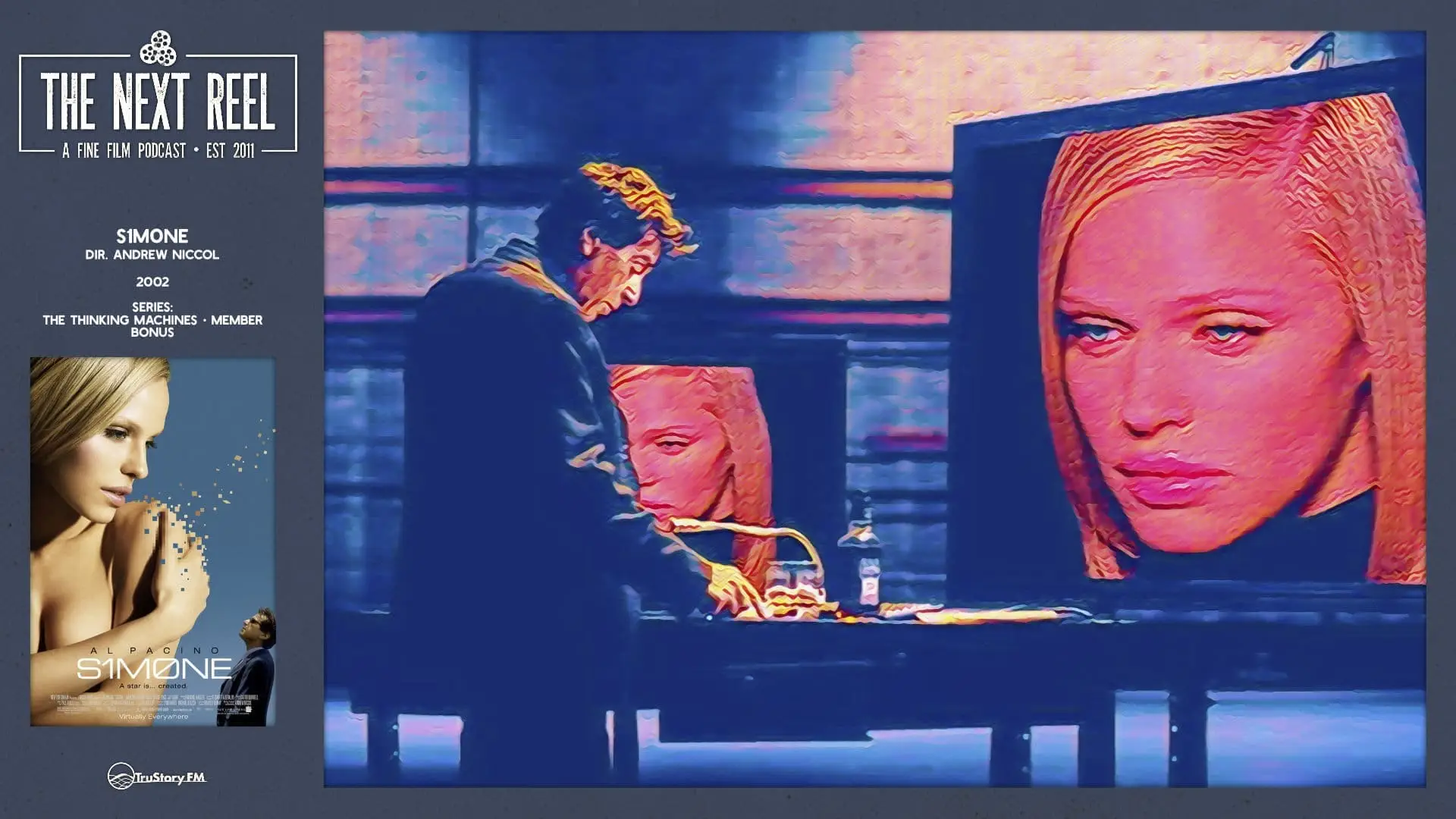
S1M0NE is over. Our ability to manufacture fraud exceeds our ability to detect it. This movie, Andy.
Andy Nelson:
Here we are.
Pete Wright:
Yeah, here we are.
Andy Nelson:
Andrew Niccol. Andrew Niccol, a director we genuinely, genuinely like. Writer-director.
Pete Wright:
Yes, absolutely.
Andy Nelson:
I mean, Gattaca is fantastic. The Truman Show, which he wrote, is fantastic.
Pete Wright:
Yeah.
Andy Nelson:
Lord of War, fantastic. In Time, but In Time is really interesting.
Pete Wright:
Strains a little bit, but wonderful. Lord of War, you said it, man. Commit to the grit, Lord of War.
Andy Nelson:
Got a sequel to that coming out that he’s working on. I’ve missed a few of his films, like The Host, Good Kill, and Anon, but—
Pete Wright:
The Host—I mean, for what it was, an adaptation of a YA dystopian book.
Andy Nelson:
Good old Stephenie Meyer. We’ve talked about plenty of her.
Pete Wright:
Right. It’s good.
Andy Nelson:
Yeah.
Pete Wright:
I mean, it does what it needs to do.
Andy Nelson:
Yeah. It does its job.
Pete Wright:
Yep.
Andy Nelson:
And he wrote the story for The Terminal. So I genuinely enjoy what Andrew Niccol is up to. And then there’s this one, Pete.
Pete Wright:
Okay. Yeah. So to say this movie was—I don’t know—ahead of its time in many respects. It was a conceit that I think was very much prescient. And I think that’s a totally fair assessment of the film. And I think to treat it as a satire, and to lean in on the audience’s impression of what they want being manifest in cinema and advertising and TV and all of that—I think that’s an interesting conceit. It is an interesting thing to take on. And maybe it’s that much more difficult. I mean, I don’t think the movie was great when it came out. I’ll just say it’s a competent film. That wasn’t a great film. But I think it’s made even harder by seeing the cultural adaptations that have come since, and how the movie ended up being wrong about some really key points. And as a sociological experiment, I think it’s fascinating. This movie is maybe one of the most interesting that we’ve talked about in our Thinking Machines series, if not one of the best. Is that too gentle? Am I being gentle on it?
Andy Nelson:
One of the best in what capacity?
Pete Wright:
Of the series. If it’s not one of the best of the series, it is one of the most interesting.
Andy Nelson:
I mean, it’s an interesting one. It’s also a tricky one for this series, because in the scope of actual thinking machines, it’s the only one that doesn’t actually fit.
Pete Wright:
Right.
Andy Nelson:
Right. Like—and we put it on the list for our members to vote on, and they picked this one. I think when the trailer came out—I had never seen it before—I thought it was more of an AI creation that he had made. I didn’t realize that no, it’s just a shell of an actress created digitally that he essentially performs. Like, Al Pacino’s character is a digital puppet that he performs for everything. He’s doing all the lines, all the programming, all the movements. And so I think in the scope of Thinking Machines, it actually doesn’t fit. But in the scope of where we are today with AI creations and AI performers, it’s actually a very interesting seed to see how things grew and changed.
Pete Wright:
Okay. I just want to talk through a couple of points, because my memory of the movie was that it was much more of a creation.
Andy Nelson:
You had seen it.
Pete Wright:
Yeah. But there are two bits in the movie where Simone is acting with agency. And the movie does not lean in on those things at all. One—he is in the audience at the Academy Awards, and she’s giving her speech, and the speech that he programmed does not thank him. And the way it could be interpreted when he says, “Why did she not say that?”—she was expressing agency. The other time was the whole setup with the interview, where she was talking on her own, and he had to run back into the studio. And why the hell do you put the computer in the middle of a thirty-thousand-square-foot sound stage? Put it by the door, man.
Andy Nelson:
Or put it in a little room, right?
Pete Wright:
Or put it in a small room.
Andy Nelson:
Like—
Pete Wright:
Yeah, what are you doing? Anyway. So I feel like those are expressions of agency that the movie never commits to. The story never commits to them. This was, for all intents and purposes, a mashup of Pygmalion and Frankenstein. And in either of those cases, the creation outshines the creator. This movie doesn’t commit to the bit. It’s like the central conceit is that Simone should have exceeded the abilities of her creator, and she never does. She only gives hints to it. Those didn’t hit you the same way?
Andy Nelson:
I think maybe it’s just sloppy construction, as far as how he created those moments. Because the way I interpreted both of those specific situations—the Oscars: it was clearly a pre-programmed creation that he had made to play at the Oscars, right? After the whole thing, it cuts to him sitting in front of his desk talking to his creation. He’s like, “Why did I leave that out? What was I thinking?” It makes it sound like—he was so much in her head as he was recording it that he didn’t even think about putting that in there. And so it seemed like—because it’s him who’s doing it—it might be weird to say, “Oh, and thank you so much, Viktor,” even though he does it plenty of other times.
Pete Wright:
Plenty of other times.
Andy Nelson:
Right. So that’s how it came off to me. Like he had just kind of forgotten that was an important part of the speech. The second one—the way that is set up, this is when it’s a table read with the other actors for a script they’re all going to be working on. And the way it plays is she starts the conversation in a way where everybody is going to go around the table and introduce themselves. It seemed like a pre-recorded start that he had set up: okay, you’re gonna go—this is how it’s gonna go. Hi everybody, so nice to meet you. I really—tell me all about yourselves. Let’s go around the table. And that was essentially the setup. And that gave him time to run and get to his computer station before everybody got through their turns, so that he could be in front of his computer as soon as that initial program ended and continue the conversation. That’s how I read both situations. I didn’t see any AI activity coming from her at all.
Pete Wright:
Okay, but did you expect the AI activity to come from her? Because I think you said it—it’s sloppy construction. I think the movie would be better if she leaned harder into the Frankenstein adaptation. That she becomes the thing that has outpaced her creator and becomes the actress. That’s the story I wanted.
Andy Nelson:
Well, that’s the story I wanted too. So I think it was a surprise to me that that’s absolutely not the story we get. It’s just a story of a puppet master. And that’s all the story is. So it was a real surprise to me that there is no AI in the film. And I think it makes it less interesting when it’s just a puppet. But maybe in 2002, that was about at the level we were ready to think about, you know?
Pete Wright:
I don’t know, man.
Andy Nelson:
I don’t know.
Pete Wright:
We’ve been talking about movies in this series from the seventies. Like we were talking about this stuff.
Andy Nelson:
That’s true.
Pete Wright:
That’s why this seems like such a whiff.
Andy Nelson:
Yeah, it really does. So it makes me think—okay, what is it actually trying to say? Because it’s not talking about AI. It’s talking about a digital creation that is a puppet played by the director. So is it a thematic deconstruction of Hollywood and the way people latch on to celebrity? It seemed more interested in that as a conversation than the actual AI or puppetry—just the way that people latch onto things.
Pete Wright:
I think that’s it. I think this is a cultural exploration more than a technological one. Because if it were a technological one, we would have had a lot more with the creation story, right? Hank would not have died in the first five minutes. We would have had some accountability for the creator, because Viktor Taransky—Pacino’s character—is a middleman. He’s a puppeteer. He’s a middleman. He didn’t create Simone. And yet that’s what we’re expected to think as the movie transitions into—look how dumb audiences are, to just let themselves be hornswoggled by this creation that does not exist. And I don’t think Niccol is disrespecting audiences in this movie. I do think that a smarter exploration of what makes humanity feel things is valuable, and I don’t think this movie finishes the conversation that it starts. I think what’s interesting about it is—look, these AI things, there might not be anything behind those eyes. It might just be digital. And to what degree do we allow ourselves to feel with them as performers—grief, and loss, and humility, and anger, and happiness, and joy—all of those feelings? Is there anything less about a digital performer than a human performer when we feel the same things from the performance? That’s the question. And I think that’s a really interesting question. I think it’s fascinating, because it really goes back to the joy of creation itself.
Andy Nelson:
But the problem is we’ve had animated films since practically the beginning of cinema. That’s the same thing. We’re getting animated performances all the time that move us. Starting with Toy Story, we started getting digital performances that have moved us. This is essentially no different. And that’s the problem—it’s basically just giving us an animated character that looks realistic enough where people buy into the fact that it’s an actual human being. That’s the only difference. And so it’s just a story about animation. And that becomes much less interesting when we don’t have the artificial intelligence element added in. Because then it’s just a story of, like, what moves people? Well, yeah—people are moved by animated characters. People love going to the Disney parks and giving Woody a hug. The people walking around look like Woody. And it’s no different than people fawning over Simone and wanting to buy whatever she’s wearing or whatever perfumes she’s putting on. Very similar sort of thing.
Pete Wright:
Very similar. And I think you’re on it. In 2001, Final Fantasy came out—the Final Fantasy movie.
Andy Nelson:
Oh yeah, right.
Pete Wright:
And that movie was writing right into Final Fantasy, trying to do photorealistic humans. And it was not a success, even though it has many things going for it. It did not do well.
Andy Nelson:
Sure. Yeah.
Pete Wright:
And I don’t know—I think making the movie the way they made it, I don’t know that they were making a movie that was going to attempt to really fool people. Which takes us back to Pacino’s character, right? So much of the weight of the movie hinges on how he thinks people are going to relate to the fraud that he thinks he’s pulling—when really he’s just an animator. He’s just putting this digital character in. He’s hiding it, ostensibly—though the film never commits to this—ostensibly because he thinks people would react negatively to knowing that this is happening. And that’s when things get out of control. Like, he is terrified explicitly because he is uncertain about what people will think about letting his actress—Winona Ryder’s character—go because of the trailer incident, and replacing her with somebody who’s much more pliable, a completely void puppet. Is that enough of a conflict story, his inner turmoil? I don’t think so. And maybe that’s the curse of watching this twenty-five years later—oh, okay, back to the well, man. This is not the conflict you think it is.
Andy Nelson:
Yeah, it makes it very difficult, because then it really just boils down to him satirizing—I mean, you said you don’t think he is—I can’t remember your words exactly—but making fun of audiences. I think he is making fun of audiences a little bit, and just generally the public perception of celebrity and the draw and the fact that people are fawning over everything she does. And certainly not just audiences, but also the Hollywood crowds—the producers, all the different production people, the other actors who are completely latching on.
Pete Wright:
His ex-wife, the producer.
Andy Nelson:
Like everything is a bit of satire. My favorite actual bit of satire in the whole thing is Jay Mohr, who I always enjoy watching. He has a moment where he’s just like, “Well, I ran into Simone.” Like the total lie of it—God, that was so perfect. He’s just like, “Well, I ran into her and she said she’d love for us to work on this project together.” Like, what a great-actor lie. That was a fantastic moment.
Pete Wright:
Totally.
Andy Nelson:
And then of course Pacino’s able to kind of prove that it didn’t happen. But that wasn’t the point—it just played really well. And so we’re getting a lot of satire about the industry and the reactions and the way that people fawn over things and the way that the paparazzi latch onto these stories as well. There certainly is quite a bit of that, for better or for worse. And I think there are interesting elements, but I don’t know if when I stepped into this film I was looking for an industry satire—just a satire about the movie business and the audiences that go to see it.
Pete Wright:
Would you say this is more of a satire against the industry and the people who make movies, or of the sort of cultural aesthetic that gravitates toward fraud?
Andy Nelson:
Well, I don’t know—that’s awkward wording, because I don’t think cultural gravitation toward fraud—it’s not like people are doing it because it’s fraud, right?
Pete Wright:
Right.
Andy Nelson:
Like, I think that’s a little unfair to—
Pete Wright:
But can be duped—that’s what I’m saying. Like the movie presents an argument that we’re duping the audience and they’re fool enough to fall for it. But I actually think the movie is a stronger indictment against the dumbness of the Hollywood elite and paparazzi and the infrastructure that makes movies than it is of the people who are watching them.
Andy Nelson:
It’s an interesting perspective. I don’t know if I think it’s strong enough to say it’s an indictment. Like, I just think the story is about how he is duping everyone, but I don’t think Niccol’s script ever makes it strong enough that that’s the point—that everyone is being duped. Like it just ends up just being a satire on—everyone’s just in love with this person. She goes down this dark road where she starts directing her own projects and releases I Am Pig, and she’s a mess on the stage and everything, and everyone still loves her and thinks how brave she is, and all this sort of stuff. And it’s like—yeah, there are definitely moments in Hollywood history where we’ve seen that, and people are drawn to that sort of stuff. Even if you’re wondering, ten years later, why was everyone falling for that again? But I don’t think he’s ever that clear that the fact he’s duping them is the thematic argument of the story.
Pete Wright:
I think you’re right. And I think it’s really interesting, because the screenplay keeps gesturing toward audience complicity—like everyone projects exactly what they want onto Simone—but the observation stays at the level of observation. That’s it. It never goes any further. It’s just a story that notices these things are happening and doesn’t really incisively peel them apart. I wanted it to go harder.
Andy Nelson:
A hundred percent, yeah. Absolutely. Like it’s just starting to scratch the surface of interesting points that it’s trying to make, and it never actually digs into them. And that made it a frustrating watch. Like the paparazzi element—just talking about that story for a bit.
Pete Wright:
Oh my God.
Andy Nelson:
We had Pruitt Taylor Vince and, young Coppola, Jason Schwartzman, as the two paparazzo—paparazzo, or is it paparazzi when it’s plural?
Pete Wright:
I just like that you committed to it the first time you said it. I think you should cut everything after. It sounded so authentic.
Andy Nelson:
So they are obsessed with Simone to the point where they think something is suspicious. But what they’re thinking—because again, no person in the film ever starts thinking that she’s fake, like that’s not a path anyone ever goes down—I was initially thinking, okay, we’re gonna have an interesting story where the two paparazzo-i are the ones who are convinced that she’s fake. Like, okay, we’re gonna have these two uncover all of this. That could take us somewhere. But no, they’re just obsessed with her, and particularly Pruitt Taylor Vince’s character thinks that Viktor Taransky has kidnapped her and is keeping her locked up in a box, because nobody gets to see her. So they go down a much darker road. And I’m like, okay, well, it’s also a less interesting road for them to take, because now nobody’s actively trying to figure out who this person is. To the point—did you watch the mid-credit sequence?
Pete Wright:
Yeah, what—let’s talk about it.
Andy Nelson:
It’s where Victor—this is after the end of the film, Viktor is doing his whole bit pretending to have the baby, like they’re a couple and it’s so stupid, his wife and daughter are in on the whole thing. At the end of it, he’s filming with a Super 8 camera in a grocery store, pushing a shopping cart down an aisle and filming it rolling. And he’s pushing it the other direction. He’s tossing frozen dinners into the cart in a way where you’re not seeing his hand, you’re just seeing the food flying into the cart. All of this we’re seeing, and then we see the digital creations of those scenes—it’s just footage of Simone on a shopping spree, buying stuff and putting her frozen dinners in the cart. And then we cut to Pruitt Taylor Vince, who’s just like, “Oh, she loves the frozen meatloaf just like me.” And it’s like—okay, so we’ve lost any interest in the paparazzi characters, because now all they are is just other people fawning over her.
Pete Wright:
Yeah, and their story functionally ended halfway through the movie. They clearly—this story did not know what to do with them.
Andy Nelson:
Right.
Pete Wright:
They took off, they’re in the plane, they’re piloting—and then they just didn’t know how to land. And that could have been an excellent tool for pulling apart the facade. But they didn’t want to pull apart the facade. The fact that it’s the technology itself that comes out to exonerate him and have him get in the town car and drive away through—I’ll say, Trope of Tropes—Teenage Savior.
Andy Nelson:
Teenager who’s so good on computers. Yeah, exactly.
Pete Wright:
Oh my God, Andy. I feel like I stand by my perspective that tropes played well are good. And this is one that is not played well. This is just so across-the-board plot sausage that I found myself very, very frustrated.
Andy Nelson:
It was. And the whole bit that led to that was so stupid. Like, okay—he announces that she’s died. And then he takes all the computer programs, the files and everything, takes them out on a boat, and dumps them in the ocean. And as soon as we cut to that—the camera—I’m like, I can see exactly where this is going, because now he’s gonna be framed for her murder. And there’s footage of him dragging a trunk to a boat. It’s like, oh God. Now we gotta go through this whole mess with him in prison. It just pushed it to a place where we lost all sense of satire. Then it’s just a plot he had to get out of.
Pete Wright:
Yeah. It became fatiguing at that point. I feel like they forgot what the movie that started was actually about.
Andy Nelson:
Is that because Niccol just never knew how to tell this story right? Like, was he the right writer to craft this?
Pete Wright:
Man.
Andy Nelson:
Could he have—knowing what he has done story-wise and film-wise—
Pete Wright:
And just how good he is, how talented he is as a storyteller, right? Let’s leave that on the table.
Andy Nelson:
Like—take Gattaca-level serious sci-fi. Could he have crafted a serious sci-fi version of this story that worked?
Pete Wright:
Yeah. I don’t know—it’s so hard to armchair it in hindsight. Because part of me thinks this movie is not enough a student of the actual AI conversations that had been going on in film before it. It was just like a therapy session. And also a therapy session that allows a director to have a conversation in public about dealing with controversial and complicated personalities in stars, right?
Andy Nelson:
Yeah, yeah.
Pete Wright:
And that’s something we’ve heard before and since—that some actors are harder to deal with than others. Interestingly, Al Pacino has a reputation for being very intense on set. Not that he’s not collaborative—like Winona Ryder was—but it is interesting that that’s the conversation that started and was never really resolved. We do get Winona Ryder coming back and having a good read with him, and for all intents and purposes he would have hired her, but Simone was already in the lead. Was that enough to address what started as the thesis of the film? I don’t think so. I don’t think this movie really ended the movie that it started.
Andy Nelson:
Well, you know what’s interesting about it? This is still relatively early in Niccol’s career, right?
Pete Wright:
Very.
Andy Nelson:
Like he had done—
Pete Wright:
So it’s like his second feature, right?
Andy Nelson:
He had directed Gattaca, that was released in ninety-seven. He wrote The Truman Show, which was released in ninety-eight. And then this. This felt to me less like he was interested in actually telling a story about AI or digital creations and how something like this could potentially work or not work in the Hollywood system. And it felt like a new filmmaker who had spent a few years in the Hollywood system and was seeing all the things that make it work and don’t work and all the things that drive people crazy. And was just like, oh my God, there’s so much to make fun of here. I want to make fun of it. That’s his decision—that was how he approached wanting to tell a story that was a satire of Hollywood. It just doesn’t feel like he was as interested in the technological advancement side of the story as he was in let’s poke fun at this crazy new world I’ve just entered.
Pete Wright:
And here is where I think that really falls apart—on the heels of directing Gattaca. Gattaca was very interested in the implications of technology—in that case, genetic technology—on the future of humanity and our cultural and societal structures. And the movie was incisive at pulling those things apart. And this movie could have been that for the coming AI evolution. It just never approached it with the level of sobriety that Gattaca brought to its subject, in a way that made it compelling for me.
Andy Nelson:
We’re living in a world right now with Tilly Norwood—this is the AI-generated actress created last year, fully synthetic, who I think at this point has had like a music video and a comedy sketch. I don’t know. I think they’re talking about more things, but I also think it’s created such a backlash from actors and people in the industry that they do not want to see this sort of thing done. One—there’s always the conversation about how AI is being trained, and people are concerned that the work of all these actors is being used without their permission or compensation for the training of Tilly to be a performer. To a certain extent, we do explore that in the film a little bit. We see him going into the library of all these different actresses, picking—oh, I want more Audrey Hepburn, oh I want a little more of this or that. So we see him using these other performers to add bits and pieces into the essence of what he’s going to create with Simone. But it never comes to the level of Tilly Norwood. And obviously the world we’re in right now has changed a lot over the last few years as far as what AI is doing, what it’s capable of. One of the things that I think had Niccol approached in the script would have absolutely made for a more interesting story—like, what if partway through the story he tells his ex-wife, for example, “Simone is made up. She’s a digital program.” He shows her the program. And she’s like, “What the hell? We just released this movie and you put a program in and people are buying it?” And then it gets out to the world, and we actually have a conversation in the film about how angry people are, how excited people are—you get an actual conversation about both sides, about what works and what doesn’t with Simone. Like, that makes for a much more interesting story than the approach he took.
Pete Wright:
Yeah, right. Because there is a story in there about the business of Hollywood and the satire that comes from Catherine Keener’s character being forced to say, “Oh my God, I hate this and I can never shut it down.”
Andy Nelson:
Yeah.
Pete Wright:
Right?
Andy Nelson:
Much more interesting.
Pete Wright:
Two other points. You mentioned Tilly Norwood—I just searched for her, and it turns out the developers posted on her Instagram that after careful consideration, they’ve made the difficult decision to deactivate Tilly Norwood indefinitely and retreat from the public eye. While Tilly remains grateful for the support of her fans, the volume of negativity and criticism has become impossible to ignore. It’s clear that the world is simply not yet ready. Blame the world, Tilly. So they euthanized her.
Andy Nelson:
Yeah.
Pete Wright:
She’s gone. They actually put her floppy disks in a crate and dumped her in the ocean. But Andy—do you remember the public feedback when they said they were gonna digitally resurrect James Dean?
Andy Nelson:
Yeah, right, right.
Pete Wright:
Right? Like they were gonna make AI puppets of James Dean. That was not that many years ago. And you can search for James Dean on IMDb—I don’t think those movies came out, did they?
Andy Nelson:
Yeah, it was a Vietnam movie. He was set to be resurrected for a new AI-driven film project—Back to Eden—following previous controversial plans for a movie called Finding Jack. His estate and filmmakers aimed to create a digital human to star in this science fiction project. Finding Jack was the Vietnam War movie, which was not released due to criticism—that was supposed to be a 2020 release. A lot of ethical debate. As for Back to Eden—while announced with high publicity, few updates as of twenty-three, leaving the project with uncertain timelines. So probably not going to happen. But the one that I am very interested in—because it’s the one that Val Kilmer was last involved in before he died—it’s a film supposed to be released this year called As Deep as the Grave, a historical drama where he plays a significant role as Father Fintan. The production used archival audio and video to recreate his likeness with his family’s consent following his death last year. He was very interested in being a part of this project—he was actively working to figure out how he could do it, and he approved the use of his likeness. So it’s also very controversial, but again, the estate has approved it. They’re apparently moving forward. I for one am interested to see what happens. And it looks like the trailer was actually released a week ago, so—
Pete Wright:
Well, I will tell you—I was just on Tilly Norwood’s Instagram page—and it turns out that was April Fool’s.
Andy Nelson:
Oh, was it really?
Pete Wright:
Yeah, she’s still there. And I think that was a very confusing thing in the comments, because so many people wanted it to be true.
Andy Nelson:
People are like, “Oh, thank God!” And then—not really, not really.
Pete Wright:
Yeah. Yep. Not really.
Andy Nelson:
Oh, too funny.
Pete Wright:
Anyway.
Andy Nelson:
So anyway, I guess we’re gonna see.
Pete Wright:
We’re here.
Andy Nelson:
Yeah, we’re here. And that’s what’s exciting—we’re in a place where people are actively having this conversation. Whether you love it or hate it, this is a conversation being had. And nobody, I think, is fawning over it like they did for Simone in this film. And I know it was twenty-five years ago, but I just think it’s a clear sign that Niccol missed a potential mark for having a more interesting conversation back then.
Pete Wright:
Yeah, that’s it. I don’t know. I feel like this movie has a place. The problem is it’s such a meta commentary on movies that are about to come out with digital actors in the same place. And look at Fast and Furious—did you not tear up when Paul’s digitally replaced face looks over in that film?
Andy Nelson:
Totally did.
Pete Wright:
Yeah, I totally teared up. I felt that—and it wasn’t real. Toy Story 3, come on, man. I’m bawling like a baby.
Andy Nelson:
Yeah, a hundred percent.
Pete Wright:
The argument this movie is making, I think, is too confused with all the arguments that it’s not. And it’s messy. I think there’s a place for it from a competent filmmaker as Niccol is. I just think it feels unfinished. And maybe that’s the gift of hindsight with all that we’ve learned since.
Andy Nelson:
Maybe. But at the time it also was not reviewed very highly.
Pete Wright:
Truly.
Andy Nelson:
So I think people even then recognized—the satire in S1M0NE lacks bite, and the plot isn’t believable enough to feel relevant. Roger Ebert said it wastes its premise by giving it broad appeal with sitcom simplicity.
Pete Wright:
Yeah.
Andy Nelson:
So yeah. I think that’s where we sit with it.
Pete Wright:
It’s like it consistently locates the right anxiety and chooses the exit that keeps everyone comfortable, again and again and again. I find that really challenging to engage with.
Andy Nelson:
Well, it is frustrating. I mean, it’s got a great cast, even though I never bought Al Pacino and Catherine Keener as a couple.
Pete Wright:
Whew. Really? Oh, that’s funny.
Andy Nelson:
Well, maybe it’s a Hollywood couple. I mean, Al Pacino—
Pete Wright:
The point is, you don’t have to buy them as a couple—you have to buy them as a divorced couple. Like I could never buy them as a couple. I do buy them divorced. The reconciliation at the end does not hold up.
Andy Nelson:
No, no, it doesn’t. And the nineteen-year difference between them—I guess that’s just a very Hollywood thing. But—Al Pacino, Catherine Keener, Pruitt Taylor Vince, Jay Mohr, Jason Schwartzman, Evan Rachel Wood, Daniel von Bargen, Winona Ryder, Elias Koteas, Rebecca Romijn. I mean, so many people in this. And then Rachel Roberts. And I guess we should just talk a little bit about her, because it’s an interesting performance she has to deliver. How do you buy—just playing a non-human, I guess. That’s the thing.
Pete Wright:
Is it?
Andy Nelson:
Like, does it come across accurately? Do you buy that she is a digital creation?
Pete Wright:
No. I never really lost myself in the performance. I mean, they imbue her with so much humanity every time she’s in a role that it felt like I was watching a human actor. Which maybe was the point. But I could never really buy into the transition from her on the screen in the sound stage to her in one of the interviews or anything like that. It just felt like—
Andy Nelson:
It’s funny, because I think they chose poorly. And I was trying to figure out—when they would show us scenes from the films she was starring in, whether it’s I Am Pig or some of the earlier films he does with her—the scenes that they showed that people were like, “Oh, she’s amazing”—I’m like, am I supposed to think that she’s Academy Award deserving? Because never did I get a performance that was actually like a performance. It always felt very stiff and small. And so I was like—was that part of the joke, or did they just not come up with more interesting scenes to actually create for her?
Pete Wright:
Was that part of the joke?
Andy Nelson:
You know? And then I kind of wanted to see some of those scenes—but I wanted to see Pacino performing it in front of his computer to create those scenes. And we never get that either. So I thought Rachel Roberts was fine, but blank. And again, for somebody that everybody in the world is buying into as this amazing actress and artist—I just never saw it.
Pete Wright:
It’s a little sad, because when she took on the role, she was put under a confidentiality agreement. She couldn’t say that she was in it. She was uncredited. And I get that was part of the gambit—that you’re not supposed to stop and think there was an actress playing the synthetic character. In the real world, she ended up marrying Andrew Niccol that year. And as far as I know, they are still married.
Andy Nelson:
Still married. Two kids.
Pete Wright:
Doing fine. Happy for them. But I never got lost in the digital part of it. And maybe that’s because I’m so accustomed to digital characters now that when I see one that doesn’t give me any sort of uncanny valley emotional response, it’s just a human—and I never got lost in the story.
Andy Nelson:
The fact that she had been a model before doing this, I think speaks to the fact that I just didn’t pull much out of her as a performer. It was just all like, yeah, yeah, all right.
Pete Wright:
Placeholder.
Andy Nelson:
Does its job. Anyone else stand out for you in the long litany of actors?
Pete Wright:
Catherine Keener was probably my favorite, just because I like Catherine Keener so much. I think she’s just always great.
Andy Nelson:
Yeah, she’s always great.
Pete Wright:
Pacino was predictably Pacino. He’s doing what he can with the material. I like that Evan Rachel Wood is in it—a movie about a synthetic performer—when she goes on to play such a central role as a robot in Westworld. That makes me—
Andy Nelson:
Oh, right.
Pete Wright:
Happy.
Andy Nelson:
Right. That’s actually an interesting one—that would make for an interesting exploration in this series.
Pete Wright:
Yeah. Right.
Andy Nelson:
Yeah.
Pete Wright:
So in the end, I think the fundamental flaw with mashing together so many source ideologies in this movie is that we never commit to one. And Niccol lets the creator off the hook. That’s the fundamental problem with the satire.
Andy Nelson:
Oh, the whole ending—everything just collapsed when we get to that. The whole thing fell apart. I was like, ugh.
Pete Wright:
Talk about not being able to land a plane, man.
Andy Nelson:
No.
Pete Wright:
That was a frustrating bit. And movies are hard. This is one with so many ideas in it that it just feels like none was allowed to shine brightest. And Niccol is a competent filmmaker—a filmmaker I trust. And this is clearly an early film. It makes me want to go back and watch the others that I like much, much more.
Andy Nelson:
I would actually be interested to see Niccol take another try with a story like this, especially now that we have the world of Tilly Norwood and digital Val Kilmer and all of these things. Just give us the Gattaca version of this for the present day. I would love to see Niccol take something like that on. I think he’d be a great choice. I just think at the time it felt like he was more interested in making fun of this crazy world of Hollywood that he’d been working in for a few years than the actual story of a synthetic human being created.
Pete Wright:
Andrew Niccol, if you’re listening—come on the show. Let’s talk about it.
Andy Nelson:
Yeah, right. There you go.
Pete Wright:
It’s such an interesting idea that I so struggle with.
Andy Nelson:
Absolutely.
Pete Wright:
The execution—I think it’s really worth it. It’s worth having stories like this that allow us to kind of frame our own thinking about these tools and what we want and what we don’t want. And that’s such an identity piece in this film—she becomes anything they want. Anything the audience demands, she can be. And that’s a really interesting discussion point in the era of such rich parasocial relationships. And we got none of that.
Andy Nelson:
Also interesting that he could program what he thought the audiences didn’t want—and because the audience cared so much about her, they would love it anyway. Like the whole I Am Pig experiment.
Pete Wright:
Yeah, that’s the parasocial tease.
Andy Nelson:
Yeah, right.
Pete Wright:
I just wanted more than a montage.
Andy Nelson:
Yeah, no kidding. All right, well, let’s move into the back half. But first, let’s take a quick break.
Pete Wright:
The Next Reel is a production of TruStory FM. Engineering by Andy Nelson. Music by Ziv Moran, Oriol Novella, and Eli Catlin. Andy usually finds all the stats for the awards and numbers at The-Numbers.com, BoxOfficeMojo.com, IMDb.com, and Wikipedia.org. Find the show and the full archive at TruStory.fm. You can follow us from there too and learn about membership. Check out our merch store at thenextreel.com/merch. And if your app allows ratings and reviews, please consider doing that for our show.
Pete Wright:
All right—how’d we do? Award season.
Andy Nelson:
Not super great. It had one nomination—one nomination for Best Supporting Actress. This was at the Saturn Awards. We love the horror-sci-fi-fantasy awards, the Saturn Awards. They nominated Rachel Roberts for Best Supporting Actress. I definitely don’t agree with that nomination. Other nominees: Sissy Spacek in Tuck Everlasting, Emily Watson in Red Dragon, Connie Nielsen in One Hour Photo, Halle Berry in Die Another Day—and the winner, Samantha Morton in Minority Report. Absolutely, of that list, I really enjoyed Samantha Morton in Minority Report.
Pete Wright:
For sure.
Andy Nelson:
So no issues with that choice.
Pete Wright:
All right. How’d we do at the box office?
Andy Nelson:
Well, Niccol had a budget of ten million dollars for this film, which is 17.6 million in today’s dollars. The movie opened August 23rd, 2002, opposite Serving Sara and Undisputed, but right out of the gate struggled to find its audience, opening in 11th place. It only lasted in theaters for six weeks, going on to earn 9.7 million domestically and 9.9 million internationally for a total gross of 34.4 million in today’s dollars. That lands the film with an adjusted profit per finish minute of $142,000, which tells me that once prints and advertising are factored in, it’s entirely possible this was a box office loser. Still, as it looks right now, it is just barely in the green, so I guess we’ll count it as a win for Niccol.
Pete Wright:
Well.
Andy Nelson:
And to that end, this is very much like Indiana Jones and the Temple of Doom—a movie that for a lot of people they don’t care for as much, but hey, the director met his wife on it and probably still has good memories of it for that reason.
Pete Wright:
Well. Yeah. I mean, okay. I guess—okay. I just wanted more from it. I don’t think I’m gonna revisit it. I think this was enough.
Andy Nelson:
Yeah. I mean, it did pique my curiosity about the rest of Niccol’s films, because I’ve missed a good number of them. I’m not super excited about The Host—the Stephenie Meyer adaptation—but I am curious to watch Good Kill. That was with Ethan Hawke again. I don’t even remember that movie coming out, honestly. Do you remember Good Kill? 2014. Drama about an Air Force officer. It had positive reviews. Maybe I should check that one out. Anon?
Pete Wright:
I haven’t done that one either.
Andy Nelson:
Cyberpunk thriller with Clive Owen and Amanda Seyfried. Set in a futuristic world where privacy and anonymity no longer exist. The plot follows a troubled detective who comes across a young woman who has evaded the government’s transparency system.
Pete Wright:
That sounds like a Gattaca-themed argument around technology—that might be a return to form.
Andy Nelson:
Yeah, it could be interesting. It was one of those Netflix pickups, so maybe isn’t as good as we hope.
Pete Wright:
I’m gonna watch it, Andy.
Andy Nelson:
But—
Pete Wright:
I’m gonna take one for the team.
Andy Nelson:
I’d like to finish his filmography. I’m definitely curious. And then he has two upcoming projects. iObject—a ten-year-old boy struggling to connect with anyone after the death of his father becomes fascinated with the everyday objects around him and envisions himself speaking to them—a live-action animated film. Karl Urban, Jemaine Clement, Anna Faris, and Skywalker Hughes are listed as being in that one. They started filming it in January 2024.
Pete Wright:
Wow.
Andy Nelson:
What the heck is going on with it? Maybe it’s the animation side, which is why it’s taking so long. Who knows?
Pete Wright:
Wow.
Andy Nelson:
And of course Lords of War—the sequel to Lord of War. He’s been working on that. I think they finished filming and are now in post-production. It’s been acquired with a theatrical release set sometime in 2027. So that’s Lords of War—Nicolas Cage. And I don’t know if Ethan Hawke is returning to that one, but Bill Skarsgård is in it.
Pete Wright:
I’ll take it.
Andy Nelson:
So—I don’t like S1M0NE, but I like Niccol enough where I think it’s gonna be worth my time to sit down and watch the three that I’ve missed just so I can check him off the list.
Pete Wright:
A hundred percent agree.
Andy Nelson:
Yeah.
Pete Wright:
A hundred percent.
Andy Nelson:
Yeah.
Pete Wright:
Worth it.
Andy Nelson:
He’s a filmmaker with things to say. And even though he was trying to say some things in S1M0NE and it didn’t work, I still appreciate that he actively is working on saying things in his films.
Pete Wright:
Yeah.
Andy Nelson:
All right, well—that is it for our conversation about Andrew Niccol’s S1M0NE. We have loved making these monthly member bonus episodes, and we’ve made a lot of them. But we’re going to take a break for a while to refocus our energy on the core of the show, and to make sure more of our conversations are available to everyone. We’re grateful you have been here for these. When we bring bonus episodes back, you’ll be the first to know. As always—when the movie ends, our conversation begins. And now, let’s do our ratings.
Pete Wright:
All right, Andy. I mean—the one thing I can guarantee you is this doesn’t get a heart from me.
Andy Nelson:
No heart for me either. Yeah. No hearts at all.
Pete Wright:
Where do you land?
Andy Nelson:
This is tough, because there were moments I enjoyed, but largely I rolled my way through the bulk of the film. And I’ve been torn. Does that mean it’s a one-star film? Is it a two-star film? One and a half? I think I’m gonna sit at one and a half. No heart is where I’m gonna land with this one. Just—it was a rough time.
Pete Wright:
Okay.
Andy Nelson:
But it could go either way if I chose to watch it again. I could see myself saying it’s just a straight-up one.
Pete Wright:
I went with two stars, no heart. And I think it’s for all of the exact same reasons you just said. Like there are enough little nuggets, and enough faith in Andrew Niccol as a competent filmmaker who just tried some things that didn’t play. It’s not wholly unwatchable, and I imagine there’s an audience for it. That audience does not include me.
Andy Nelson:
Right. Absolutely. Well, that averages out to 1.75, which rounds up to two. You can find the show on Letterboxd at @thenextreel. You can find me there at @sodacreekfilm and Pete at @petewright. So—what did you think about S1M0NE? Or as Pete likes to call it, Simone? We would love to hear your thoughts. Hop into the Showtalk channel over in our Discord community, where we will be talking about the movie this week.
Pete Wright:
When the movie ends—
Andy Nelson:
Our conversation begins.
Pete Wright:
Letterboxd giveth, Andrew.
Andy Nelson:
As Letterboxd always doeth.
Pete Wright:
All right, where’d you land?
Andy Nelson:
I went super high. I was scrolling through the five stars—more people than I thought really, really love this movie. I went with five stars and a heart by Vane, who says: “It gets five stars simply for the lipstick scene, sudden cut to an over-the-top funeral procession, and the jail cell scene. I like absurd movies.”
Pete Wright:
Okay. Well, I’ve got Ashton who comes in with a half star and a heart, which is always an interesting sort of—
Andy Nelson:
Wow.
Pete Wright:
I know. I understand that vibe. Like you know you don’t like it, but man, you like it.
Andy Nelson:
Yeah, yeah.
Pete Wright:
“Al Pacino creating S1m0ne and making her talk about how much of a genius he is has real Kanye West creating Robert Kardashian hologram energy.” It’s so good. Can I do one more—there was one right below that that I think is really funny?
Andy Nelson:
Yeah.
Pete Wright:
Two and a half stars from Paolo Carone. “Added to my list of hilarious failures that I will bask in forever. Andrew Niccol doesn’t understand Hollywood, popular culture, technology, psychology, women, children, or CGI. This list will expand with future viewings. Also, if you drank every time someone in the film says Al Pacino’s character’s name, you would die.”
Andy Nelson:
There is a lot of Viktor Taransky. Viktor, Viktor, Viktor. Yeah.
Pete Wright:
Anyway, that’s good stuff. Thanks, Letterboxd.